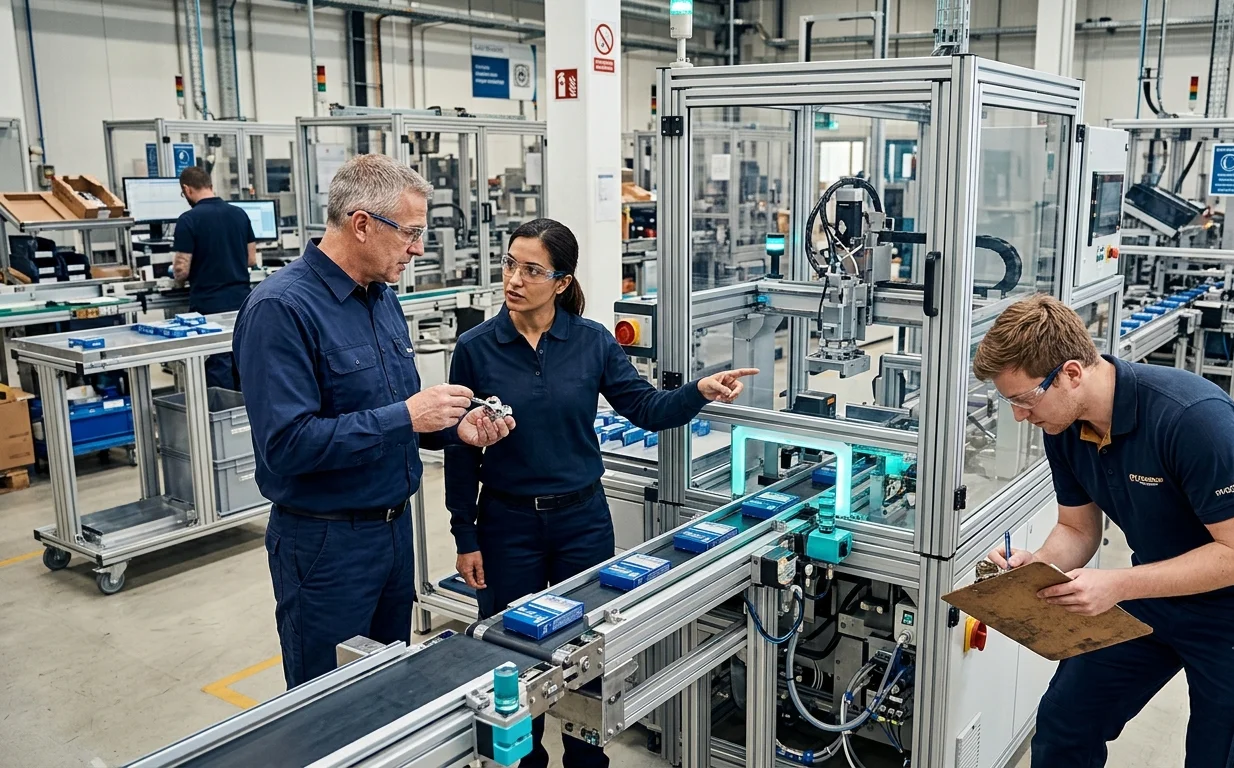
Why Automation Companies Need Sales Engineers Who Understand Production
Successful automation Sales Engineers understand manufacturing processes, integration risks, customer applications and measurable operational outcomes.
By LAK Consulting Group
Executive Summary
Industrial automation is sold into production environments where every decision has consequences for throughput, quality, safety, labour, maintenance and delivery. Customers do not buy control systems, robotics, sensors or software simply because the technology is capable. They invest when a supplier can show how the solution will improve a real production outcome without creating unacceptable integration or operational risk.
This makes Sales Engineers central to automation growth. The strongest professionals understand manufacturing processes, customer applications, technical architecture and the economics of improvement. They can identify the actual constraint in a production environment, shape a credible solution with engineering colleagues and communicate value to operational, technical and commercial stakeholders.
Recruitment is difficult because this capability develops through practical exposure. A technically knowledgeable salesperson may lack manufacturing-process experience. A skilled Production or Application Engineer may have limited commercial ownership. Employers should assess candidates through evidence of how they have solved customer problems, managed implementation risk and converted technical credibility into sustainable business.
Introduction
Automation projects are rarely simple product transactions. A customer may need to improve a bottleneck, reduce variation, introduce a new product, address labour constraints, improve traceability or make a legacy process easier to maintain. The equipment must work within an existing production system that has its own machinery, controls, safety requirements, operating routines and commercial pressures.
Sales Engineers sit at the point where these factors meet. They need to understand what is happening on the line, ask the right questions and distinguish a visible symptom from the underlying problem. Their work determines whether the company proposes an appropriate solution or simply presents a catalogue of technology.
The role has become more demanding as automation products become more connected and integrated. Customers expect suppliers to understand data, controls, robotics, sensing, software, safety and service alongside the physical process. Technical credibility is therefore an essential commercial asset.
The Customer Buys an Outcome, Not a Component
An automation supplier may offer sophisticated hardware and software, but customers assess the effect on their own production environment. They want to know whether the solution will increase output, reduce scrap, improve consistency, create safer work, shorten changeovers or provide useful operational visibility.
These outcomes are connected to the process. A faster machine is not valuable if the bottleneck sits downstream. A vision system may detect quality problems without resolving their root cause. A robot may improve a manual operation while creating new constraints in material handling, fixturing or maintenance.
Sales Engineers need to explore the complete application. They should understand the product being made, the current flow of work, the source of variation, the relevant quality measures and the customer’s ability to implement change. This enables them to position technology as part of an operational solution.
Understanding Production Processes
Production knowledge is not a generic skill. The relevant detail differs between discrete manufacturing, process industries, food and beverage, packaging, life sciences, battery production, precision assembly and other environments. Each has its own constraints, terminology, quality risks and investment logic.
Strong Sales Engineers develop practical insight through time on customer sites, commissioning activity, application support or prior operational roles. They know how to observe a process, listen to operators and challenge assumptions without appearing to second-guess the customer’s expertise.
Recruitment should look for this evidence. Candidates should be able to describe specific processes, the issues customers faced and how their proposed solution affected the wider operation. A broad claim of “manufacturing experience” is less valuable than a clear understanding of real production decisions.
Identifying the True Constraint
Customers often describe a problem through the most visible symptom. They may ask for more automation because output is low, when the underlying cause is changeover time, inconsistent incoming material, poor scheduling or an unreliable upstream machine. A Sales Engineer who accepts the initial request without investigation can create a solution that disappoints both parties.
The role requires structured discovery. What is the desired outcome? Where does performance currently fall short? Which data exists? How does the process behave across products, shifts and operating conditions? What constraints would remain if the proposed equipment were installed?
This work builds trust because it demonstrates that the supplier is interested in the customer’s result. It also protects commercial quality by preventing an opportunity from advancing before technical and operational assumptions have been tested.
Translating Needs into an Automation Concept
Once the problem is understood, Sales Engineers need to translate it into a concept that engineering teams can evaluate. They should define the process boundary, target outcome, key interfaces, required data and acceptance criteria without prescribing every technical detail prematurely.
Engineering and Application colleagues then assess feasibility, architecture, safety, integration effort and performance risk. The Sales Engineer keeps the proposal connected to the customer’s priorities while ensuring that commercial commitments reflect technical evidence.
The strongest professionals are comfortable with this dialogue. They can explain trade-offs to customers, protect the integrity of the solution and avoid promising functionality that has not been validated. Their credibility depends on being both responsive and realistic.
Integration Risk Is a Commercial Issue
Automation projects can fail commercially when integration risk is underestimated. The new system may need to work with legacy equipment, variable products, limited site space, existing safety arrangements, customer software or third-party machinery. Installation may also require downtime that the customer cannot easily accommodate.
Sales Engineers need to surface these issues early. They do not need to solve every technical detail alone, but they must recognise where specialist input is required and make sure that risks are reflected in scope, timing and commercial terms.
Candidates should be assessed for how they managed difficult integration situations. Did they involve engineering early? How did they respond when site conditions differed from the original assumption? Which commitments did they challenge before a contract was signed?
The Importance of Application Engineering
Application Engineers often provide the technical depth that turns a commercial opportunity into a workable design. They can analyse process requirements, test concepts, configure equipment and support customer trials. Their work is especially important in special machinery and complex automation applications.
Sales and Application roles need a close relationship. Sales Engineers bring customer context, commercial responsibility and opportunity management. Application Engineers bring detailed technical validation. When the two operate separately, proposals can become either commercially attractive but technically weak, or technically impressive but disconnected from customer priorities.
The Growing Shortage of Application Engineers in Special Machinery considers why these profiles are difficult to secure. Automation companies should design their commercial teams so that both capabilities are visible to customers and integrated internally.
Quantifying Operational Value
Customers need a credible basis for investment. Sales Engineers should be able to connect a proposed solution with measurable factors such as output, scrap, rework, labour, changeover time, availability, energy use, safety or traceability. The analysis does not need false precision, but it must reflect the customer’s real operating model.
This is where production understanding becomes commercially powerful. A candidate who understands how a plant measures performance can ask for the right data and avoid misleading comparisons. They can also identify where the customer may need to validate an assumption before committing to a project.
Value cases should be developed jointly with the customer and internal technical teams. This creates alignment around both the potential benefit and the conditions required to achieve it.
Selling to Multiple Stakeholders
Automation decisions usually involve several groups. Production leaders focus on output and disruption. Engineering teams assess technical feasibility and maintainability. Quality and safety stakeholders examine risk and evidence. Finance considers investment, cash flow and returns. Operators and maintenance teams judge whether the solution will work in practice.
Sales Engineers need to adapt the conversation without changing the underlying truth. The same solution should be explained through relevant outcomes for each audience, supported by evidence that is appropriate to their role. A technical presentation alone will not secure executive approval, while a financial case without engineering credibility will not survive site review.
This requires preparation and internal coordination. Strong candidates can describe how they built stakeholder maps, handled disagreement and moved an opportunity from technical interest to a decision with clear ownership.
Robotics, Motion and Machine Vision
Automation Sales Engineers may work with robotics, motion systems, machine vision, control platforms, sensors, industrial software or complete production cells. Each technology creates different application questions, but the commercial principle remains the same: performance has to be understood in the context of the process.
For robotics, this may include cycle time, payload, reach, tooling, safety, part presentation and error recovery. For vision, it can include lighting, inspection criteria, product variation, false rejects and data integration. For motion and controls, relevant questions include machine dynamics, synchronisation, commissioning and operator interface.
Employers should not assume that familiarity with a product category guarantees application competence. The candidate needs to show how they applied technology to achieve a measurable outcome while managing the limitations of the production environment.
Connected Automation and Data
Customers increasingly expect automation suppliers to provide data, diagnostics, traceability and remote support. These capabilities can improve visibility and service, but they also introduce questions about connectivity, cybersecurity, data ownership and integration with existing systems.
Sales Engineers need enough understanding to describe the practical value and identify where technical specialists should contribute. They should not treat connectivity as an automatic advantage. A customer may need clear evidence of how data will improve decisions, who will use it and how the system will be supported.
The Talent Behind Industrial Connectivity and Edge Electronics examines the engineering capability behind this increasingly important part of automation offers. Commercial teams need to make sure that the promise remains aligned with what the product and support organisation can deliver.
Safety, Compliance and Risk
Automation solutions can affect machine safety, worker interaction, product quality and regulatory obligations. Sales Engineers need to recognise when proposed changes create requirements for safety assessment, validation, documentation or specialist review.
They are not expected to replace safety or compliance experts. Their responsibility is to ensure that the opportunity is scoped honestly and that critical questions are addressed before commitments are made. This protects customers, employees and the company’s reputation.
Candidates should be able to explain how they have handled safety-sensitive discussions. Experience of declining unsuitable applications or delaying a proposal until risks were understood can demonstrate strong commercial judgement.
Managing the Sales Cycle
Automation projects can involve long and uncertain sales cycles. Customers may need internal approval, technical trials, capital planning, supplier comparisons and production windows for installation. A Sales Engineer must maintain momentum while recognising that the process cannot be rushed beyond operational reality.
Strong opportunity management includes qualification, stakeholder mapping, technical validation, value development, commercial negotiation and clear next steps. It also includes the discipline to disqualify projects that lack a credible need, sponsor, budget or implementation route.
Employers should assess candidates for the quality of their pipeline, not only historic revenue. A large collection of unqualified opportunities can consume application and engineering capacity without producing reliable growth.
Working with Delivery and Service Teams
The commercial relationship does not end when an order is received. Sales Engineers need to support an effective handover to Project, Engineering, Commissioning and Service teams. Customer expectations, site constraints, commercial commitments and unresolved questions should be documented clearly.
Weak handovers create avoidable conflict. Delivery teams inherit promises they did not help shape, while customers discover that their interpretation differs from the supplier’s. Strong Sales Engineers remain involved appropriately through early delivery and use lessons learned to improve future proposals.
This feedback loop is particularly important in automation because each project can reveal new application knowledge. Companies that connect sales, delivery and service build more credible solutions over time.
Why the Talent Pool Is Scarce
The role combines technical knowledge, manufacturing understanding, customer communication and commercial discipline. These capabilities are usually developed through years of exposure to products, applications, sites and delivery. Few candidates have had responsibility across the complete cycle.
Titles can be misleading. Sales Engineer may describe a highly technical, consultative role in one company and a product-focused account position in another. Application Engineer may include sales ownership in some organisations but not others. Employers should therefore focus on evidence rather than title similarity.
The market is also competitive. Good automation Sales Engineers are valued by equipment suppliers, system integrators, robotics businesses, software providers and specialist engineering companies. Candidates with trusted customer relationships may have several options.
Recruiting from Adjacent Markets
Relevant talent can be found in special machinery, process equipment, industrial software, material handling, packaging, energy technology and technical services. The key is to assess comparable customer and application complexity.
A candidate from machine building may understand production constraints and project delivery but need exposure to the specific automation portfolio. Someone from industrial software may understand data and commercial models but need stronger physical-process knowledge. These gaps can be addressed when the company has a clear onboarding plan and experienced application support.
Recruitment should not depend on a perfect competitor match. Broader talent mapping can identify adjacent pools, assess transferable experience and show where direct-market candidates are concentrated.
Assessing Sales Engineers Through Real Opportunities
Interviews should explore completed and lost opportunities in depth. Candidates should describe the production challenge, stakeholders, process investigation, proposed solution, technical validation, commercial case and delivery outcome. Interviewers should ask what changed during the sales cycle and how the candidate responded.
Technical peers should test application understanding, while commercial leaders assess qualification, negotiation and account development. A practical case can be useful if it mirrors a realistic manufacturing problem and allows the candidate to ask clarifying questions before offering a solution.
The strongest candidates do not jump immediately to a product. They first seek to understand the process, outcome, constraints and implementation context. This behaviour is a strong indicator of how they will represent the company with customers.
Building and Retaining the Team
Automation companies should create career paths that recognise both technical and commercial contribution. Some Sales Engineers may progress into key-account, business-development or leadership roles. Others may become senior application or vertical-market specialists. Treating every path as a move away from technical work can weaken retention.
Development should include exposure to manufacturing sites, commissioning, service cases and new product development. This helps Sales Engineers maintain credibility and understand how the company’s offers perform beyond the sales presentation.
Compensation should reward quality as well as volume. Incentives that encourage premature commitments can damage delivery and customer relationships. Measures related to margin, qualified pipeline, customer success and repeatability support more sustainable behaviour.
Executive Perspective
Executives should decide which production problems and customer segments the business is best placed to solve. This provides a clear framework for Sales Engineer recruitment, application support and technical investment. A generic request for “automation sales experience” is unlikely to produce the capability the company needs.
The role mandate should describe the customer environment, product scope, decision authority and expected relationship with application, delivery and service teams. Candidates can then be assessed for comparable work and supported appropriately where product knowledge must be developed.
LAK Consulting Group supports technical and business-critical recruitment and commercial leadership recruitment for industrial automation and manufacturing-technology businesses.
Conclusion
Automation companies need Sales Engineers who understand production because customers buy operational outcomes, not technology in isolation. The strongest professionals can investigate a process, identify the real constraint, shape a credible solution and align technical, commercial and delivery stakeholders around measurable value.
Recruitment is difficult because the role requires both manufacturing depth and commercial ownership. Employers should assess candidates through real customer situations, implementation risk and delivered results rather than relying on product familiarity or job titles.
Companies that build this capability will win better opportunities and execute them more reliably. By connecting Sales Engineering with application expertise, delivery and service, they can become a more credible partner to manufacturing customers and create growth that lasts beyond a single project.
Frequently Asked Questions
What does an automation Sales Engineer do?
An automation Sales Engineer works with customers to understand production challenges, define appropriate technical solutions, develop a value case, coordinate internal expertise and manage the opportunity through commercial decision and handover to delivery.
Why is manufacturing-process knowledge important in automation sales?
It helps the Sales Engineer identify the true constraint, assess integration risk and connect the proposed technology with outcomes such as throughput, quality, availability, safety or labour efficiency.
How does an automation Sales Engineer differ from an Application Engineer?
Sales Engineers usually own customer development and commercial progression, while Application Engineers provide detailed technical analysis, configuration and validation. The exact split varies, but successful automation companies integrate the two roles closely.
Can companies recruit automation Sales Engineers from adjacent industries?
Yes. Relevant candidates can come from machine building, process equipment, industrial software, material handling or technical services. Employers should assess comparable process complexity, customer engagement and commercial responsibility.
How should employers assess automation Sales Engineer candidates?
They should examine specific opportunities from discovery to delivery, including process understanding, stakeholder management, technical validation, commercial decisions and customer outcomes. To discuss a specific requirement, contact LAK Consulting Group.
Discuss Your Recruitment Strategy
Every organisation faces different commercial, technical and leadership challenges. If you are planning to strengthen your team, expand into new markets or recruit for a business-critical position, we would be pleased to discuss your objectives and share our perspective on the market.
Book a Consultation