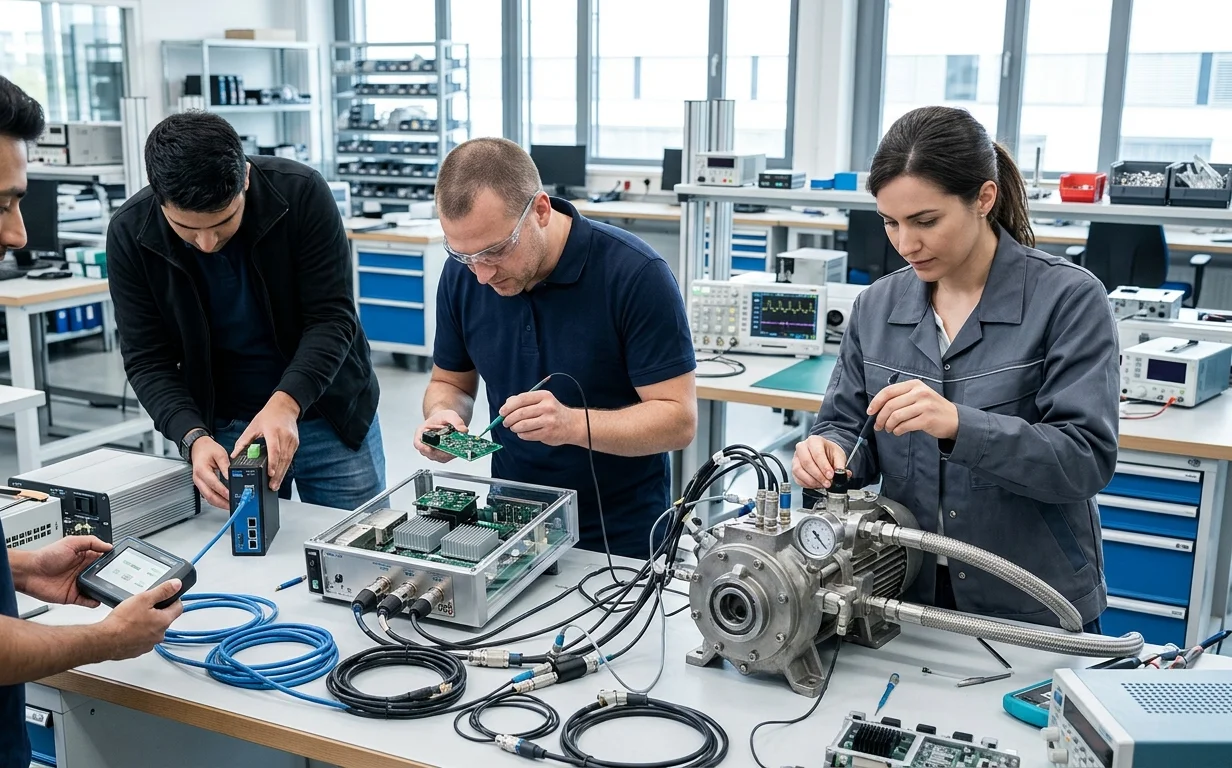
The Talent Behind Industrial Connectivity and Edge Electronics
Connected industrial products depend on specialists in embedded hardware, communication protocols, sensors, cybersecurity and edge computing.
By LAK Consulting Group
Executive Summary
Industrial products are becoming more connected, intelligent and responsive. Machines, energy assets, instruments and control systems increasingly collect information, make local decisions, communicate with other equipment and support remote visibility. Delivering this capability requires more than adding a network connection or sensor to an existing product.
Companies need engineers who can integrate embedded hardware, sensing, communications, real-time software, edge computing, cybersecurity and physical product design. These specialists are difficult to recruit because their work sits across disciplines that have traditionally developed separately. A strong embedded engineer may not understand industrial networks; a communication specialist may lack product-lifecycle experience; and a cybersecurity professional may have limited exposure to constrained, safety-relevant equipment.
The best-connected products are developed by complementary teams with clear system ownership. Employers should define the operational problem, architecture and lifecycle responsibility before recruiting. They should assess candidates through evidence of delivered products, deployment constraints and cross-functional decisions rather than by titles or individual tools alone.
Introduction
Industrial connectivity has moved beyond basic monitoring. Connected products can provide operational data, support predictive maintenance, enable remote service, coordinate with production systems and improve the way customers use equipment. Edge electronics makes it possible to process information close to the physical asset, where timing, bandwidth, privacy or resilience make a purely centralised approach unsuitable.
These opportunities create new engineering dependencies. Sensors need appropriate analogue interfaces, calibration and environmental protection. Communication links need reliable protocols, antenna design, security and graceful handling of interruptions. Edge software must work within limits for power, memory, processing and real-time behaviour. The complete system must be maintainable for years after it is installed.
Talent strategy must reflect that complexity. Organisations that treat connectivity as an isolated software feature often underestimate the hardware, operational and cybersecurity work required to deliver a dependable product.
Why Connectivity Has Become a Product Capability
Customers increasingly expect equipment to provide more than its immediate physical function. They want visibility of condition and performance, easier integration with existing systems, faster diagnosis when problems occur and confidence that critical assets can be managed efficiently. Suppliers also see opportunities to improve service, understand installed-base behaviour and develop data-enabled offers.
The product itself is changing as a result. A connected machine may need new electronics, sensors, local processing, communication modules, software interfaces and operating procedures. It may also require new capabilities in technical support, cybersecurity, data governance and product management.
The relevant engineering work is therefore not limited to a digital team. Mechanical, electrical, firmware, controls, service and application specialists all influence whether a connected product will work in the customer’s actual environment.
The Industrial Context Is Different
Industrial equipment operates under constraints that are uncommon in many consumer technologies. It may be installed for a decade or more, exposed to vibration, temperature variation, dust, moisture or electrical interference, and maintained by people working under time pressure. It may also be part of a process where unexpected downtime or incorrect behaviour carries significant operational consequences.
Connectivity must respect those conditions. Hardware must be robust, communications must tolerate interruption and updates must be controlled carefully. Data may need to remain local because of latency, contractual requirements or network availability. The product cannot depend on ideal connectivity or frequent manual intervention.
Candidates with conventional software or consumer-device experience can add valuable skills, but employers should assess how they have handled physical constraints, long lifecycles and industrial users. Transferability depends on the operating environment, not the technology label alone.
Embedded Hardware and Electronics Design
Connected industrial products begin with hardware that can capture, process and communicate information reliably. Engineers need to select processors, memory, power supplies, interfaces, sensors and communication modules while balancing cost, availability, energy use, thermal performance and future flexibility.
The role becomes more complex when electronics are integrated into existing mechanical products. Space, enclosure design, connectors, electromagnetic compatibility and service access can all shape what is possible. A technically capable board may still be unsuitable if it cannot survive the product’s environment or be manufactured and repaired effectively.
Employers should look for candidates who understand these trade-offs. Relevant evidence includes architecture choices, design for manufacture, component obsolescence management, environmental testing and collaboration with mechanical and software colleagues. Recruiting for the Next Generation of Electronic Systems explores the wider demand for this multidisciplinary electronics capability.
Sensors and Measurement Quality
Connectivity is only as valuable as the information it receives. Sensors translate physical conditions into data, but their performance depends on selection, positioning, calibration, signal conditioning, sampling and environmental effects. Noise, drift, vibration, temperature and installation quality can all distort interpretation.
Sensor specialists need to understand both the physics of measurement and the operating decision that the data will support. A highly accurate reading may be unnecessary if the real need is to detect a clear change in condition. Conversely, an inexpensive sensor can create false confidence if its limitations are not understood.
Product teams should involve application, service and reliability experts when defining sensing requirements. They can identify which measurements are meaningful in real operating conditions and how the resulting information should be used by customers or support teams.
Analogue, Digital and Signal-Processing Expertise
Many industrial sensing and control challenges occur at the boundary between analogue and digital electronics. Engineers need to capture weak or variable signals, remove unwanted noise, digitise data and process it without losing relevant information. The design may need to operate close to motors, power electronics or other sources of interference.
This capability is difficult to replace because it combines specialist technical knowledge with practical product experience. Candidates may come from instrumentation, medical devices, automotive electronics, energy systems or industrial automation, but their relevance depends on the signals, environment and constraints they have handled.
Employers should assess how candidates validated measurement performance, diagnosed unexpected behaviour and worked with software teams to turn signals into reliable inputs. This reveals more than a list of component or tool experience.
Communication Protocols and Network Design
Industrial products may communicate through wired Ethernet, serial interfaces, fieldbuses, cellular connections, Wi-Fi, low-power wireless links or specialised industrial protocols. Each option affects range, bandwidth, latency, security, installation, cost and support requirements.
Engineers need to understand more than the protocol itself. They must consider how the product will be commissioned, identified, configured, updated and diagnosed within the customer’s environment. A communication choice can also affect compatibility with control systems, gateways, cloud services and partner equipment.
Network specialists with industrial experience are valuable because they understand that interoperability is a commercial as well as a technical issue. Customers may reject a product that cannot fit established architectures, even if the product’s own functionality is strong.
Wireless Connectivity and Radio-Frequency Design
Wireless connections can enable flexible installation and access to equipment where cables are impractical. They also introduce challenges around antenna placement, interference, range, power use, environmental effects and regulatory requirements. Enclosures, metal structures and nearby equipment can change performance materially.
Radio-frequency and antenna specialists are therefore important in many connected products. They need to work closely with mechanical, electronics and software teams because physical design decisions can determine whether a communication concept works outside a laboratory.
Candidates should be able to explain how they validated wireless performance in realistic environments and how they managed fallback behaviour when connectivity was limited. Purely theoretical RF knowledge is not enough for products that must be installed and supported at scale.
Embedded Software and Real-Time Behaviour
Embedded software connects hardware inputs, control functions, communications and local decision-making. It must often operate within tight constraints for memory, processing power, timing and energy use. In industrial equipment, predictable behaviour can be more important than maximum computational sophistication.
The work includes drivers, operating systems, communication stacks, diagnostics, data handling, local control logic and update mechanisms. Engineers need to understand the hardware they are controlling and the consequences of software behaviour when an asset is operating in the field.
The Growing Demand for Embedded Systems Engineers considers why this profile is increasingly contested. For connected industrial products, employers should pay particular attention to experience of integration, test, fault handling and long-term support.
Edge Computing and Local Intelligence
Edge computing allows data to be processed close to the equipment that produces it. This can reduce latency, preserve bandwidth, improve resilience and keep sensitive or high-volume data within the local environment. It can also enable local detection, control or optimisation when a remote service is unavailable.
The edge is not simply a smaller cloud. Engineers must decide what information should be processed locally, what should be transmitted and how software will be managed across a distributed installed base. They need to consider hardware capability, operating-system choices, model or algorithm performance, data quality and security.
The strongest candidates understand the operational purpose. They can explain why a decision belongs at the edge, how the solution behaves when data is incomplete and how the product will be updated or maintained after deployment.
Data Architecture and Product Lifecycle
Connected products create data flows across sensors, embedded electronics, gateways, customer systems, service tools and potentially remote platforms. Ownership and quality must be defined across that path. Without clear architecture, teams can create duplicated data, inconsistent identifiers and support problems that become harder as the installed base grows.
Product leaders need to determine which data is essential, who can access it, how long it should be retained and how it supports customer value. These decisions affect technical design, contractual arrangements, cybersecurity and future commercial models.
The lifecycle must be considered from the beginning. A connected product may need remote diagnostics, software updates, configuration management, version visibility and end-of-life processes. The design cannot assume that every customer site will allow unrestricted access or rapid change.
Cybersecurity as an Engineering Requirement
Connected industrial products expand the number of interfaces that must be protected. Risks can arise through communication links, credentials, remote access, software dependencies, service tools, supplier components and updates. The response needs to be proportionate to the product, operating environment and potential impact.
Cybersecurity specialists must work with embedded and operational teams. Security controls that are impractical to install, maintain or recover from may be bypassed or create new operational risks. Conversely, a product cannot treat convenience as a reason to leave access and update processes undefined.
Relevant candidates combine technical depth with judgement. They understand threat modelling, secure development, identity, encryption and vulnerability management, but can also work within constrained hardware and complex customer environments. Employers should assess evidence of delivered security practices rather than relying solely on qualifications or vocabulary.
Interoperability and Standards
Industrial customers rarely buy equipment in isolation. Products need to work with existing machines, control systems, enterprise applications and service processes. Interoperability can therefore determine whether a technically strong product is accepted or rejected.
Engineers and Product Managers must understand which interfaces are essential for the target market and how much configuration or custom development customers will tolerate. Open protocols may improve compatibility, while proprietary elements can support differentiation when they deliver genuine value.
The key is to make deliberate choices. A product that promises universal integration without a clear architecture can create expensive support obligations. A product that is too closed may limit adoption in environments that require established standards.
Verification and Field Testing
Connected products need testing across electronics, software, communications, security and real-world operation. Laboratory validation is important, but field testing reveals installation variation, network behaviour, interference, user practices and service constraints that may not appear in controlled conditions.
Verification teams need to design meaningful evidence. They should consider normal and degraded states, loss of communication, sensor faults, software updates, recovery procedures and compatibility with surrounding systems. The purpose is to understand how the product behaves when conditions are imperfect, not merely to demonstrate ideal performance.
Candidates with experience of field trials, customer pilots and post-deployment investigation can be particularly valuable. They help organisations convert early lessons into repeatable product and support processes.
The Role of Systems Engineering
Systems Engineers provide the discipline that connects requirements, interfaces, architecture and verification. They help teams understand how electronics, software, mechanics, communications and operations combine into a complete product.
The role is especially important when a company is adding connectivity to an established product range. Existing teams may understand their own components deeply, but the new connected capability introduces dependencies that sit between functions. Systems engineering makes those dependencies visible and gives the organisation a structured way to manage them.
Employers should define the system boundary and decision rights clearly. A Systems Engineer who only maintains requirements documentation may not provide the technical integration leadership required for a complex connected product.
Service and Customer-Success Capability
Connectivity can improve service, but it also changes customer expectations. Customers may expect quicker diagnosis, more proactive support and better visibility of asset condition. Service teams need access to the right data, training in new tools and clear escalation paths into engineering.
These teams provide essential feedback. They see how products are installed, which alarms matter, where configuration fails and what customers actually need. Product companies should involve them in design decisions and use their experience to improve future releases.
Recruitment should consider whether service professionals can work confidently with connected systems. Traditional mechanical or electrical troubleshooting remains valuable, but it now needs to be complemented by understanding of diagnostics, software versions, networks and remote support.
Technical Product Management
Connected products require Product Managers who can make trade-offs between customer value, engineering effort, cybersecurity, serviceability and commercial model. They need to avoid treating every digital feature as equally valuable and create a roadmap that reflects a clear target user and operating environment.
This role is difficult because candidates may come from engineering, software, applications or commercial backgrounds. Why Electronics Companies Struggle to Recruit Technical Product Managers explains why titles reveal little about the decisions an individual has actually owned.
For industrial connectivity, the strongest Product Managers understand that a remote feature can create lifecycle obligations. They define how the value will be delivered, supported and priced before development effort is committed.
Why the Talent Pool Is Limited
The required experience is dispersed across industrial automation, electronics, telecommunications, automotive technology, medical devices, energy systems and software. Candidates who have delivered connected physical products are valuable to several of these markets.
Job titles add to the difficulty. An IoT Engineer may work on hardware, cloud integration, data platforms or product deployment. An Embedded Engineer may have deep firmware experience without network or security responsibility. A Cybersecurity specialist may understand IT infrastructure but not constrained equipment or industrial operations.
Employers should map capability through delivered work. Relevant questions include: what physical system did the candidate connect, which interfaces did they own, how was it tested, what happened after deployment and how did they manage security and updates?
Recruiting from Adjacent Industries
Direct competitors are not the only source of talent. Automotive suppliers, industrial automation businesses, medical-device companies, energy technology providers, telecommunications firms and specialist electronics organisations can contain relevant profiles.
Transferability should be assessed through constraints and lifecycle experience. A candidate from automotive telematics may bring robust embedded and wireless capability but need exposure to industrial protocols. An automation engineer may understand controls and site operation but need deeper product-software experience. A medical-device specialist may bring strong verification discipline while adapting to different customer environments.
Companies should identify these gaps openly and design onboarding around the product architecture and customer context. Adjacent hiring is most effective when the role itself is precisely defined.
Assessing Candidates Through Evidence
Interviews should explore connected-product work in depth. Candidates should describe the operational problem, system architecture, personal responsibility, key interfaces and constraints. They should explain what was tested, how security and updates were handled and what feedback emerged after deployment.
Technical peers can assess depth in hardware, software, communications or security. Cross-functional interviewers should assess how candidates worked across disciplines and made trade-offs. For senior roles, questions should explore how the person structured teams, managed suppliers and protected lifecycle quality.
A bounded case discussion can be useful if it reflects real industrial conditions. Strong candidates will clarify the user, environment, data and support model before recommending technology. They will identify uncertainty rather than offering a generic connectivity solution.
Building and Retaining Capability
Connected-product talent remains valuable because it can move across sectors. Retention depends on technical challenge, meaningful ownership, strong peers and the ability to see products reach customers. Engineers become frustrated when connectivity programmes are repeatedly treated as isolated experiments without clear product or operational commitment.
Companies should create development paths that expose specialists to the complete lifecycle. Hardware engineers benefit from understanding field deployment, while software and data professionals gain judgement from working with physical products and service teams. Technical leadership paths should reward integration capability as well as functional depth.
Knowledge management also matters. Architecture decisions, field lessons and security processes need to survive staff changes. Repeatable design patterns and cross-functional reviews make the organisation less dependent on individual experts.
Executive Perspective
Before opening a search, leaders should define what connectivity is intended to achieve for customers and the business. The answer may be improved service, operational insight, product differentiation, remote support or a new data-enabled offer. Each objective implies different technical and commercial requirements.
The role should then be designed around outcomes and interfaces. Leaders need to decide who owns architecture, cybersecurity, data, service readiness and product lifecycle. This clarity attracts stronger candidates and prevents one appointment from being expected to solve every unresolved issue.
LAK Consulting Group supports technical and business-critical recruitment and talent mapping for industrial technology companies building electronics, embedded software and connected-product capability.
Conclusion
Industrial connectivity and edge electronics are reshaping how products are designed, operated and supported. The opportunity depends on more than technology: it requires people who can integrate sensors, hardware, communications, embedded software, edge processing and cybersecurity within the realities of industrial use.
Recruitment is difficult because those capabilities are scarce and distributed across several industries. Employers should define the product and operating problem, assess candidates through real delivery evidence and build complementary teams rather than search for a universal expert.
The companies that succeed will treat connectivity as a durable product and operational capability. By linking technical design with field deployment, service and lifecycle ownership, they can create connected industrial products that customers trust and continue to use.
Frequently Asked Questions
Which specialists are needed for connected industrial products?
Typical teams include embedded-hardware and firmware engineers, sensor and signal-processing specialists, communication and network engineers, edge-software developers, cybersecurity professionals, Systems Engineers, verification teams and technical Product Managers.
Why is edge computing important in industrial equipment?
Processing data close to the asset can reduce latency, preserve bandwidth, improve resilience and support local decisions when a remote connection is unavailable. The correct balance between edge and remote processing depends on the application and operating environment.
How does cybersecurity affect industrial product development?
Cybersecurity affects architecture, credentials, communication links, remote access, software dependencies and update processes. It must be designed alongside hardware and operations so that controls remain practical throughout the product lifecycle.
Can companies recruit connectivity specialists from automotive or telecommunications sectors?
Yes. These sectors can provide valuable hardware, wireless, software and cybersecurity experience. Employers should assess transferable constraints and provide onboarding for industrial protocols, customer environments and long product lifecycles.
How should employers assess candidates for edge-electronics roles?
They should examine delivered products, system interfaces, operating constraints, test evidence, security practices and post-deployment responsibility. To discuss a specific requirement, contact LAK Consulting Group.
Discuss Your Recruitment Strategy
Every organisation faces different commercial, technical and leadership challenges. If you are planning to strengthen your team, expand into new markets or recruit for a business-critical position, we would be pleased to discuss your objectives and share our perspective on the market.
Book a ConsultationRelated Articles