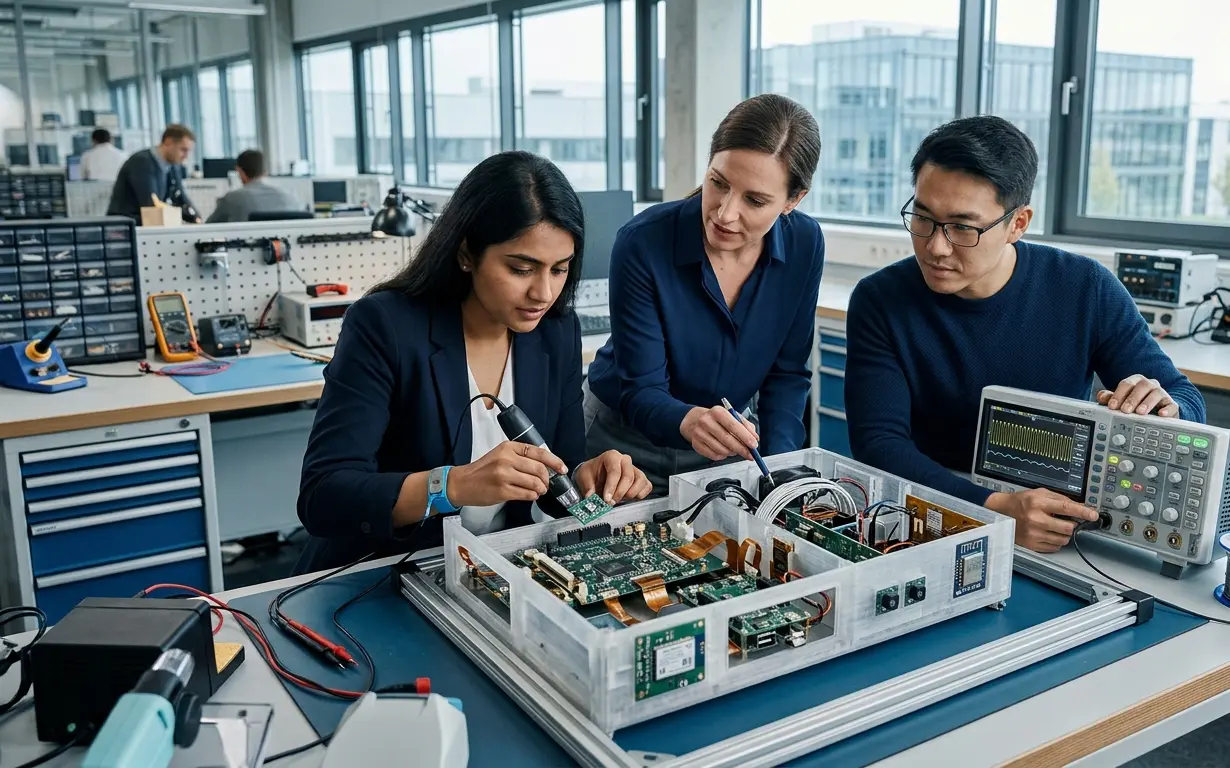
Recruiting for the Next Generation of Electronic Systems
Advanced electronics, miniaturisation, sensing, communications and intelligent connected devices are increasing demand for multidisciplinary engineering talent.
By LAK Consulting Group
Executive Summary
Electronic products are becoming smaller, more connected and more intelligent while operating within tighter requirements for power, reliability, security and cost. Industrial equipment, energy systems, aerospace platforms, medical technology and advanced machinery increasingly depend on electronics that combine sensing, processing, communications and control.
Developing these systems requires more than isolated hardware or software expertise. Companies need System Architects, analogue and digital designers, embedded developers, radio-frequency specialists, sensor engineers, packaging and thermal professionals, validation teams and Product Managers who understand how these disciplines interact.
Recruitment is difficult because the strongest candidates are relevant to several expanding sectors and have experience that cannot be inferred from job titles alone. Organisations need to define system responsibilities precisely, assess practical ownership across the product lifecycle and build development paths that preserve specialist depth. Companies that assemble complementary teams rather than search for one universal electronics expert will be better positioned to convert advanced technology into reliable products.
Introduction
Electronics have moved from supporting industrial products to defining much of their behaviour and value. Sensors capture physical conditions, processors interpret information, communications connect equipment and embedded software determines how systems respond. The mechanical product and the electronic system can no longer be designed independently.
At the same time, physical and commercial constraints are becoming more demanding. Customers expect more functionality in smaller packages, often with lower energy use and greater reliability. Products may need to operate for years in harsh environments while remaining secure and maintainable.
These requirements create interdependent design decisions. A more capable processor may affect power and thermal performance. A compact enclosure can change antenna behaviour and serviceability. Wireless connectivity introduces software, security and certification considerations. Talent strategy needs to reflect the complete system.
Why Electronic Systems Are Becoming More Complex
Product intelligence increasingly resides across several electronic layers. Sensors and analogue front ends capture real-world information. Processing and embedded software interpret it. Communications connect the product to other devices or services. Power-management electronics support efficient and stable operation.
Each layer has specialised requirements, but system performance depends on their interaction. Noise from a power stage can affect sensing. Software timing can influence communications and control. Packaging can change temperature, signal integrity and electromagnetic behaviour.
The organisation therefore needs people who understand interfaces as well as components. Specialists remain essential, but their work must be coordinated by clear architecture and shared verification.
Complexity also extends into the lifecycle. Components become obsolete, security threats evolve and customers expect updates. Development decisions need to consider manufacturing, maintenance and future product variants rather than initial functionality alone.
European Electronics and Skills Capability
Semiconductors underpin electronic products across industrial, communications, aerospace, medical and energy applications. The European Chips Act identifies research, design, manufacturing, advanced packaging, supply resilience and skills as connected priorities for Europe's semiconductor ecosystem.
Electronic-system employers participate in this wider talent market even when they do not manufacture chips. They need engineers who can select, integrate and validate semiconductor technologies within demanding applications.
The competition reaches universities, research organisations, component suppliers and product manufacturers. Candidates with advanced design or validation experience can choose between different technologies and end markets.
Employers need a proposition that explains the technical significance of the product, the quality of the engineering environment and the authority attached to the role. General statements about innovation are unlikely to distinguish one opportunity from another.
Systems Architecture
System Architects translate product objectives into a coherent technical structure. They define functions, boundaries, interfaces and key trade-offs across hardware, software, communications, power and mechanics.
The role requires breadth without replacing specialist depth. Architects need enough understanding to challenge assumptions and recognise dependencies. They also need decision authority; architecture that exists only as documentation cannot guide development.
Experienced candidates are scarce because system judgement develops across product cycles. They have seen how early choices affect validation, manufacturing and field performance. Their value comes partly from recognising risks before they become visible in individual disciplines.
Recruitment should assess the scale and consequence of architectures candidates have owned. Maintaining a subsystem design differs from defining a complete connected product. Employers should also clarify whether the role is hands-on, advisory or accountable for technical approval.
Analogue and Mixed-Signal Expertise
Sensors and physical interfaces depend on accurate analogue design. Engineers work with signal conditioning, conversion, filtering, noise and power while accounting for component variation and environmental conditions.
Mixed-signal systems are difficult because digital activity can affect sensitive analogue performance. Layout, grounding, power integrity and packaging choices become part of the design rather than tasks left to the final PCB stage.
Experience is particularly valuable in low-signal, high-precision or safety-related applications. Engineers develop judgement through laboratory investigation and repeated exposure to unexpected behaviour.
Candidates may come from instrumentation, medical devices, industrial sensing, automotive, aerospace or semiconductor applications. Transferability depends on signal, environment and validation requirements rather than the product label alone.
Digital Hardware, FPGA and Processing
Digital hardware engineers select processing architectures and develop the logic, memory and interfaces needed by the product. Some systems use microcontrollers or processors, while others require programmable logic or custom devices for timing, throughput or functional integration.
The role interacts closely with embedded software and system architecture. Hardware decisions affect available processing, update strategy, cybersecurity and long-term component support.
FPGA and digital-design specialists are relevant to communications, aerospace, imaging, instrumentation and control. Their experience may be highly transferable, but employers should distinguish device familiarity from deeper knowledge of architecture, verification and timing.
Assessment should explore how candidates validated designs and handled changes after hardware release. The ability to create logic is important; the ability to integrate it reliably into a complete product is more valuable.
Embedded Software and Hardware Integration
Embedded software gives electronic systems much of their behaviour. Developers work close to hardware, manage limited resources and implement functions that may need deterministic or safety-related performance.
The strongest engineers understand how software interacts with peripherals, power states, communications and physical processes. They can diagnose problems that cross the boundary between code and electronics.
Our article on the growing demand for Embedded Systems Engineers examines this market in greater detail. The recruitment pressure is strongest where candidates combine low-level development with architecture, verification and product understanding.
Hardware and software teams need shared ownership of interfaces. Organisations that separate them too rigidly discover integration issues late. Team design should create regular technical review without expecting every engineer to become equally deep in both fields.
Sensors and Measurement Systems
Sensors allow electronic products to understand their environment. Applications can involve temperature, pressure, position, movement, chemical properties, light, sound or other physical conditions.
Sensor engineering extends beyond choosing a component. Placement, calibration, environmental protection, signal conditioning and interpretation affect whether the measurement is useful. The application may also require compensation for drift, interference or variation.
Companies need specialists who understand the physical measurement and its system consequences. Candidates may have backgrounds in physics, electronics, instrumentation or application engineering.
Recruitment should define whether the role focuses on transducer development, electronics, algorithms, calibration or complete sensing architecture. A broad sensor title can otherwise attract professionals with very different capabilities.
Connectivity and Communications
Connected devices need reliable communication within their operating environment. The appropriate technology depends on range, data, power, latency, infrastructure and security. Industrial products may combine wired and wireless interfaces across local and wider networks.
Radio-frequency Engineers address antennas, propagation, matching and electromagnetic interaction. Protocol and embedded specialists implement communication behaviour. System teams need to understand how connectivity affects product architecture and customer integration.
Miniaturisation can make RF design more difficult because antenna space and ground conditions are constrained. Enclosures, nearby components and product orientation influence performance.
Candidates from telecommunications, automotive, consumer, aerospace and industrial electronics may bring relevant expertise. Employers should assess the communication problem and operating conditions rather than insisting on identical end-market history.
Miniaturisation and Packaging
Smaller products create challenges across electronics, mechanics and manufacturing. Component density affects heat, signal integrity, assembly and test access. Packaging also needs to protect the system from vibration, moisture, contamination or other environmental exposure.
PCB, mechanical, thermal and manufacturing Engineers need to collaborate early. A layout that performs electrically may be difficult to assemble or cool, while a compact enclosure can restrict antenna or service performance.
Advanced packaging and integration specialists are valuable because they connect materials, processes and reliability. Their skills may exist within semiconductor, electronics manufacturing or high-performance product organisations.
Recruitment should examine evidence from physical builds and testing. Miniaturisation expertise is demonstrated through decisions that survived manufacture and use, not visual compactness alone.
Power Management and Energy Efficiency
Electronic systems need stable and efficient power across different operating states. Battery devices face energy and charging constraints, while industrial products may need to tolerate demanding supply conditions.
Power-management Engineers work with conversion, distribution, sequencing, protection and low-power behaviour. Their decisions affect thermal performance, reliability and product size.
The market overlaps with broader electrification. Why Power Electronics Engineers Have Become Critical to Electrification explores the demand for higher-power conversion expertise. Electronic-system roles may operate at different scales but share important design principles.
Employers should define whether the position requires converter design, power integrity, battery management or system-level energy optimisation. Combining all of these into one profile can make recruitment unnecessarily restrictive.
Cybersecurity and Product Lifecycle
Connectivity creates security responsibilities that continue after product launch. Architecture needs to consider identity, access, update, data and component trust. Security cannot be added reliably after hardware and software interfaces are fixed.
Product-security professionals work with system, embedded and cloud teams to identify risk and define controls. They need enough product understanding to propose measures that support real operation.
Lifecycle planning is equally important. Products may remain in service longer than individual components or software dependencies. Organisations need a strategy for updates, vulnerability response and supported configurations.
Recruitment should clarify whether the role owns governance, engineering implementation or both. Strong candidates understand how security decisions affect usability, service and cost.
Verification and Reliability
Advanced electronics require evidence that systems perform across expected conditions. Verification should cover individual functions and interactions between hardware, software, communications and mechanics.
Test Engineers need technical breadth and diagnostic judgement. When a result is unexpected, they must determine whether the cause lies in the product, setup, environment or requirement.
Reliability professionals work with component selection, stress, environmental testing and field data. Their insight should influence design rather than appear only after failures.
These roles can be difficult to recruit because experienced candidates are relevant across many high-reliability sectors. Employers should position verification as a technical discipline with design influence, not a final checking function.
From Prototype to Manufacture
A prototype can demonstrate functionality without proving that the product can be produced consistently. Industrialisation requires component availability, assembly processes, test methods and configuration control.
Manufacturing Engineers and New Product Introduction specialists connect development with production. They identify where design choices create yield, inspection or service problems.
Supply-chain capability also matters. Electronic components can have different lifecycles and sourcing structures from the mechanical product around them. Procurement needs technical input to qualify alternatives and manage obsolescence.
Design and manufacturing teams should share responsibility for readiness. Throwing a completed design “over the wall” creates delay and hides the learning needed for the next product.
Application Engineering and Customer Integration
Electronic systems often become components within a customer's larger product or operation. Application Engineers help customers understand interfaces, performance and integration requirements.
The role needs technical breadth and communication. Strong professionals can diagnose whether a problem arises from the device, customer design or interaction between them. They also recognise when a request would require product change.
Semiconductor and component companies depend particularly on this capability. Recruiting Semiconductor Sales and Application Engineers explains how technical application knowledge supports design-led commercial growth.
Recruitment should distinguish presales support, implementation and field troubleshooting. These activities require related but different experience and working patterns.
Product Management
Electronic product roadmaps need to balance technology, customer value and development capacity. Product Managers translate market evidence into priorities and decide where standard platforms should support different applications.
The role requires enough technical understanding to evaluate feasibility and dependencies. It also needs commercial judgement to distinguish one customer's request from a scalable market need.
Technical Product Managers are difficult to recruit because candidates often develop from engineering or commercial backgrounds and need to build the other side. Employers should assess decision evidence rather than expect a uniform career path.
Authority needs to be clear. Product Managers cannot maintain a roadmap if founders, sales or engineering can change priorities without governance.
Recruiting Across Adjacent Industries
Electronic-system capability transfers across industrial automation, automotive, aerospace, medical technology, telecommunications, energy and consumer products. Adjacent hiring expands the market and can introduce new design methods.
Transferability depends on the technical problem and consequence. An RF Engineer may adapt across products more readily than a regulatory specialist. A safety-critical embedded developer may bring valuable discipline to industrial control but need application context.
Employers should define the knowledge that must be immediate and the knowledge that can be learned. Structured onboarding should include product architecture, operating environment, development standards and customer use.
The surrounding team needs enough domain depth to support transitions. Adjacent recruitment works best as part of a balanced capability plan, not as a response to every specialist gap simultaneously.
Assessing Electronic-System Candidates
Job titles and tool lists provide limited evidence. Recruitment should examine what candidates designed, which decisions they owned and how the work performed through validation and production.
Useful areas to assess include:
- how the candidate translated product requirements into architecture or detailed design;
- how they managed interfaces across hardware, software and mechanics;
- how they investigated an unexpected laboratory or field result;
- how component and lifecycle risk influenced design;
- what verification evidence supported release;
- how they worked with manufacturing, quality and suppliers;
- which trade-offs they made around power, size, performance and cost;
- how they communicated technical risk to non-specialist leaders.
Practical scenarios can reveal reasoning. Candidates should clarify constraints and identify dependencies before proposing a component or architecture.
Assessment should remain role-specific. A specialist design position needs depth, while an architect or technical leader requires breadth and influence. Using the same interview for both weakens decision quality.
Building Complementary Teams
Electronic-system organisations sometimes search for one engineer who can own hardware, firmware, communications, testing and certification. Broad capability is valuable, but excessive combination creates dependency and limits depth.
Team design should identify critical authorities and interfaces. Specialists need clear ownership, and system leadership needs the power to resolve cross-disciplinary decisions.
Smaller companies can use external partners for selected work, but they should retain enough architecture and product knowledge to govern decisions. Outsourcing every specialist discipline leaves the organisation unable to assess integration risk.
Workforce planning should follow the product roadmap. New connectivity, sensing or miniaturisation requirements create capability needs before development begins, not after integration problems appear.
Developing and Retaining Expertise
Technical career paths help retain senior electronics professionals. Principal, architecture and specialist-authority roles can provide progression without forcing every engineer into people management.
Development needs access to real product responsibility, laboratories and experienced mentors. Training is valuable, but judgement develops through design, test and failure analysis.
Engineers also value technical standards and appropriate tools. Persistent schedule pressure, unclear priorities and repeated redesign make external opportunities more attractive.
Knowledge should not remain concentrated in individuals. Design reviews, architecture records and mentoring convert personal experience into organisational capability while preserving accountability.
Executive Perspective
The future of electrical engineering and electronics lies in systems that combine advanced components with software, connectivity and physical products. Leadership teams need to understand which capabilities create differentiation and which can be sourced externally.
Recruitment should begin with the system architecture and roadmap. If the next product depends on sensing, RF or advanced packaging that the organisation does not possess, the gap should be addressed before programme schedules are fixed.
Market mapping can identify specialists across electronics and adjacent sectors, but the employer proposition needs substance. Strong candidates evaluate technical authority, product credibility, tools and leadership as closely as compensation.
LAK Consulting Group supports electronics businesses through technical talent acquisition, business-critical talent acquisition and talent mapping and market intelligence.
Conclusion
Next-generation electronic systems integrate sensing, processing, communications, power and software within increasingly demanding physical products. Their success depends on specialists who understand individual disciplines and leaders who maintain system coherence.
Recruitment is challenging because these skills are scarce, transferable and demonstrated through practical product ownership rather than titles. Organisations need precise roles, balanced teams and structured adjacent-sector hiring.
Companies that build capability before the roadmap creates urgent demand will be better positioned to develop reliable, manufacturable and commercially relevant products. Electronics organisations planning specialist or leadership appointments can contact LAK Consulting Group to discuss candidate availability and recruitment strategy.
Frequently Asked Questions
Which specialists are needed for next-generation electronic systems?
Common requirements include System Architects, analogue and digital designers, embedded developers, RF Engineers, sensor specialists, packaging and thermal professionals, verification teams and technical Product Managers.
Why are multidisciplinary electronics candidates difficult to recruit?
Their skills are relevant across industrial, automotive, aerospace, medical, communications and energy markets. Practical system judgement also takes several product cycles to develop.
Can electronics engineers transfer between industries?
Yes, when the underlying design problems are comparable. Employers should assess technical fundamentals and provide structured onboarding for application, standards and customer context.
Should one engineer own hardware and software?
Broad ownership can work in smaller products, but complex systems usually need complementary specialists and clear interface leadership. Combining too much responsibility creates technical and succession risk.
How can companies retain senior electronics specialists?
Credible technical career paths, meaningful authority, appropriate tools, sustainable programmes, mentoring and recognition of specialist contribution all support retention.
Discuss Your Recruitment Strategy
Every organisation faces different commercial, technical and leadership challenges. If you are planning to strengthen your team, expand into new markets or recruit for a business-critical position, we would be pleased to discuss your objectives and share our perspective on the market.
Book a ConsultationRelated Articles
Electrical Engineering & Electronics
Why Electronics Companies Struggle to Recruit Technical Product Managers
Electrical Engineering & Electronics
Why Power Electronics Engineers Have Become Critical to Electrification
Electrical Engineering & Electronics