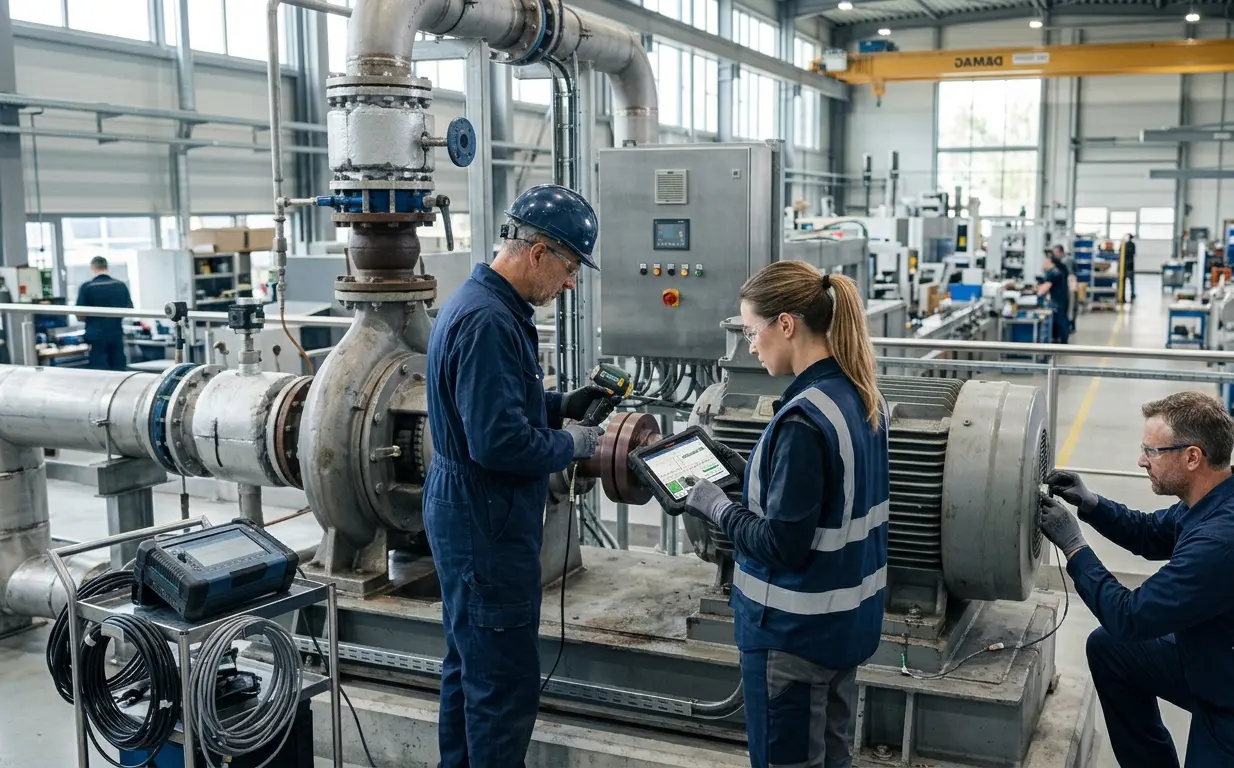
Recruiting Industrial AI and Predictive-Maintenance Specialists
Manufacturers need specialists who can convert production data into reliable maintenance, quality and operational improvements.
By LAK Consulting Group
Executive Summary
Manufacturers are generating more operational data through connected machines, sensors, control systems and production software. Yet access to data does not automatically produce better maintenance, quality or operational performance. Companies need professionals who can understand physical equipment, prepare imperfect industrial data, develop dependable analytical methods and integrate the resulting insight into daily plant decisions.
These specialists are difficult to recruit because the work crosses disciplines that have traditionally developed separately. Data Scientists may understand modelling but lack experience of failure mechanisms and production constraints. Reliability Engineers may know the equipment but have limited experience of data pipelines or machine learning. Automation professionals may understand controls and connectivity without having owned analytical products through deployment and adoption.
Successful recruitment starts by defining the operational problem rather than asking broadly for an “industrial AI expert”. Employers should identify the assets, decisions and outcomes in scope, then assess candidates for evidence that they have taken solutions beyond a proof of concept. The strongest teams combine domain knowledge, data engineering, analytical expertise and plant-floor credibility instead of expecting one individual to master the entire stack.
Introduction
Predictive maintenance has long promised to identify emerging equipment problems before they become expensive failures. Advances in sensing, connectivity, computing and analytical methods have expanded what is technically possible. Similar approaches can help detect process drift, identify quality risks, improve asset utilisation and support more consistent operating decisions.
The practical challenge is not simply building an algorithm. Industrial environments contain varied equipment, changing operating conditions and incomplete records. Machines may produce data at different frequencies and through different interfaces. Maintenance events are recorded inconsistently, while rare failures provide limited examples for model development.
An effective specialist must navigate this reality without losing sight of the operational purpose. The value lies in enabling a maintenance planner, operator or engineer to make a better decision at the right time. Recruitment should therefore focus on the complete path from physical asset to sustained operational use.
Why Demand Is Increasing
Manufacturers face pressure to improve availability, quality, energy efficiency and cost performance while dealing with ageing assets and constrained technical resources. Unplanned downtime can disrupt production schedules, create scrap and consume scarce maintenance capacity. At the same time, routine preventive work can waste resources when it is performed without regard to actual equipment condition.
Connected assets create an opportunity to use evidence more intelligently. Vibration, temperature, current, pressure, acoustic and process data can reveal changes that precede failure or indicate unstable operation. Production and quality data can show relationships that are difficult to observe through individual systems alone.
Companies therefore need professionals who can connect data with equipment behaviour. Demand is emerging across manufacturers, automation suppliers, machine builders, condition-monitoring providers, industrial software companies and specialist consultancies. The same limited talent pool is being approached from several directions.
Industrial AI Is Not Conventional Data Science
Industrial analytics differs from many consumer or transactional data applications. The data represents physical processes, and an incorrect conclusion can affect safety, production or equipment life. A model may perform well historically yet fail when a product variant, operating mode or maintenance practice changes.
Failures are also comparatively rare, which is desirable operationally but difficult analytically. Labels may be uncertain because maintenance records describe symptoms rather than root causes. Sensors can drift, be replaced or operate under different sampling conditions. A candidate who has worked only with clean, centralised datasets may underestimate these challenges.
Strong industrial specialists treat domain understanding as part of the analytical method. They ask how the machine operates, which failure modes matter, what signals are physically plausible and how an intervention would be executed. This makes collaboration with reliability, maintenance and process experts essential.
The Core Talent Profiles
Industrial AI programmes require several complementary capabilities. Data Engineers create dependable pipelines from machines, historians, manufacturing systems and maintenance records. Data Scientists and Machine Learning Engineers develop methods for anomaly detection, diagnosis, prediction and optimisation. Reliability or Condition-Monitoring Engineers connect patterns to failure mechanisms and maintenance actions.
Automation and OT specialists provide knowledge of control systems, industrial networks and plant constraints. Software or platform engineers turn analytical work into maintainable applications. Product Managers or programme leaders define use cases, align stakeholders and ensure that investment follows operational value.
The exact balance depends on the company’s starting point. A technology supplier building a scalable product needs different depth from a manufacturer deploying solutions across a defined asset base. Recruitment should reflect the intended operating model rather than copy a generic digital-industry team structure.
Starting with the Operational Decision
Vague ambitions such as “use AI to reduce downtime” produce vague job specifications. Employers should identify the decision the solution must improve. This might be whether to inspect a bearing during the next planned stop, whether a process deviation requires intervention or which assets should receive limited maintenance attention first.
The decision defines the necessary prediction horizon, accuracy, explanation and delivery method. A warning that arrives minutes before failure has little value if maintenance requires several days of planning. A highly sensitive model may overwhelm the team with false alarms. A useful solution therefore depends on workflow as much as technical performance.
Candidates should be able to explain how they translated a business or engineering problem into an analytical target. They should discuss who used the output, what action followed and how the organisation measured improvement.
Understanding Equipment and Failure Modes
Predictive-maintenance specialists need a practical appreciation of how industrial assets fail. They do not have to be expert in every machine type, but they should know how to work with engineers who understand mechanical, electrical and process behaviour.
For rotating equipment, relevant signals may include vibration, speed, load, lubrication and temperature. Electrical assets may require current, thermal or insulation-related evidence. Complex production machinery can involve interactions between mechanics, drives, controls, materials and operator settings.
The best candidates avoid treating every change in data as a fault. They investigate operating context and alternative explanations. This disciplined curiosity is particularly important in special machinery, where application variation and limited fleets can make purely statistical approaches unreliable.
Data Foundations and OT Integration
Many industrial AI projects are constrained by data access before modelling begins. Information may sit across PLCs, SCADA systems, historians, maintenance software, quality databases and local spreadsheets. Naming conventions and timestamps may be inconsistent, and context such as product type or operating state may be missing.
Candidates with genuine deployment experience understand these foundations. They can work with automation and IT teams to establish reliable data flows, asset structures and governance without disrupting production. They recognise cybersecurity and access constraints rather than treating them as obstacles to bypass.
This requirement creates overlap with the market for controls talent explored in Hiring PLC and SCADA Specialists in Europe. Industrial analytics teams do not replace automation expertise; they depend on it to understand where data originates and how insights can be returned safely to operations.
From Signals to Trustworthy Models
The most sophisticated model is not necessarily the most useful. Industrial applications often benefit from methods that are robust, interpretable and practical to maintain. Thresholds informed by engineering knowledge, signal-processing techniques and statistical monitoring may outperform an opaque machine-learning approach when data is scarce.
Candidates should demonstrate judgement in selecting methods. They need to explain how they handled imbalanced data, changing operating regimes, missing values and sensor quality. They should also distinguish detection, diagnosis and prediction. Identifying that behaviour is unusual is different from identifying the cause or estimating remaining useful life.
Validation should reflect real operating conditions. Randomly dividing historical records can create misleading results when information from the same machine or event appears in both training and test data. Strong specialists test performance across time, assets and operating states and remain transparent about uncertainty.
Moving Beyond the Proof of Concept
Industrial companies have accumulated many successful demonstrations that never became operational systems. A pilot may show an interesting pattern on a small dataset but lack the data infrastructure, user workflow or ownership required for scale. The underlying equipment may also change before the solution is deployed.
Recruitment should seek evidence of productionisation. Has the candidate monitored model performance after deployment? How were alerts delivered and investigated? Who owned data quality and system support? What happened when sensors, operating conditions or equipment configurations changed?
Experience of stopping or redesigning an unproductive use case is also valuable. Mature specialists know that not every problem requires AI and that the cost of maintaining a solution must be justified by the operational benefit.
Creating Adoption on the Plant Floor
Maintenance technicians and operators possess knowledge that is rarely captured fully in digital systems. They also carry responsibility for responding to alerts. If an analytical tool repeatedly produces false positives or offers no understandable basis for action, trust can disappear quickly.
Effective specialists involve users early. They learn how work is planned, what evidence technicians need and how feedback can improve the system. They communicate uncertainty honestly and design outputs around decisions rather than dashboards alone.
This calls for humility and communication ability as well as technical depth. During assessment, employers should explore how candidates handled scepticism, incorporated frontline expertise and changed a solution in response to operational feedback.
Applying Industrial AI to Quality
The same talent can support quality improvement by connecting process conditions with inspection results and product outcomes. Applications may include detecting process drift, identifying combinations of parameters associated with defects or prioritising investigation when measurements move outside their normal relationships.
Quality use cases often require data from several production stages. Traceability, timing and product context become central. A model must distinguish a meaningful process change from normal variation between products, materials, shifts or tools.
Candidates should understand that prediction does not establish causation. Analytical findings need engineering investigation and controlled validation before changes are made to a production process. Professionals who can connect modelling with structured problem-solving are especially valuable.
Improving Operational Performance
Industrial data can also support throughput, energy and asset-utilisation decisions. Specialists may identify recurring micro-stoppages, unstable process states or interactions that constrain output. However, optimisation across a production system is more complex than improving an isolated machine.
A local change can shift a constraint downstream or create additional quality risk. Successful candidates think in terms of the wider process and involve the appropriate operations and engineering stakeholders. They are interested in measurable outcomes rather than the volume of models developed.
This systems perspective is increasingly relevant as embedded intelligence becomes part of industrial equipment itself. The Growing Demand for Embedded Systems Engineers examines the talent required to connect software, electronics and physical products at that level.
Why Job Titles Can Mislead
Relevant candidates may be called Industrial Data Scientists, Machine Learning Engineers, Reliability Engineers, Condition-Monitoring Specialists, Analytics Engineers, Digital Manufacturing Engineers or IIoT Solution Architects. Some of the strongest profiles may not use AI in their title at all.
Conversely, a candidate with an AI title may have worked mainly on demonstrations without responsibility for operational deployment. Search strategies that rely on titles and keywords will miss transferable talent and can overvalue superficial matches.
Employers should map the capability around problems, assets and deployment experience. This broadens access to candidates from automation, asset management, machine building, energy, process industry and industrial software while maintaining a clear standard of relevance.
Assessing Candidates Effectively
Assessment should follow one or two projects from initial problem definition to operational result. The candidate should explain the physical system, available evidence, chosen method, validation approach and user workflow. Interviewers should probe what failed, what changed and which outcome was measured.
Technical depth remains important, but assessment should be appropriate to the role. A Data Engineer should demonstrate architecture and data-quality judgement. A Condition-Monitoring Specialist should connect signals with failure modes. A programme lead should show how use cases were prioritised and adopted across functions.
A practical case can reveal reasoning if it uses a realistic but bounded scenario. The strongest candidates will clarify the maintenance decision, challenge the available data and consider deployment conditions before proposing a modelling technique.
Building a Complementary Team
Few individuals combine deep data engineering, machine learning, reliability, automation and change leadership. Searching for a universal expert can delay hiring and create an unstable role. Companies should instead determine which capabilities must be internal and which can be supplied through existing teams or partners.
A manufacturer with strong reliability expertise may need data and software capability. A technology provider with a mature platform may need application specialists who understand customer assets and workflows. A central analytics team may require site-based champions who can validate use cases and support adoption.
Clear interfaces are as important as individual expertise. Teams need agreement on who owns the use case, data pipeline, model, application, maintenance action and ongoing performance. Recruitment should close defined gaps within that structure.
Leadership and Governance
Industrial AI requires leadership across operations, engineering, maintenance, IT and OT. Without shared priorities, projects can become isolated technical experiments. Governance should focus on operational value, risk and lifecycle ownership rather than creating unnecessary bureaucracy.
Leaders need a portfolio view of use cases. They should consider potential benefit, data readiness, scalability, user adoption and maintenance cost. Early projects should build organisational capability as well as produce results.
Candidates for senior roles must be able to communicate with plant teams and executives. They should challenge unrealistic expectations while demonstrating a credible route from data to measurable improvement.
Retaining Scarce Specialists
Industrial AI professionals want technically meaningful work, but they also want to see their work used. Repeated pilots without deployment, poor access to equipment experts or weak data foundations can quickly become frustrating. Retention improves when specialists have clear ownership and direct contact with operational users.
Career development should allow movement between technical depth, product leadership and operational responsibility. Exposure to different assets and sites can broaden expertise, while communities of practice help prevent specialists from becoming isolated within individual plants.
Companies should also invest in the surrounding team. A scarce expert cannot compensate indefinitely for missing data engineering, reliability or software capability. Sustainable retention depends on creating an environment in which high-quality work can reach production.
Executive Perspective
Before recruiting, leaders should identify the operational outcome, assets and decisions that matter. They should understand what data exists, which functions must participate and who will own the solution after deployment. This preparation turns a fashionable technology brief into a credible role.
The candidate profile should then be built around the most important capability gap. Evidence of operational delivery should receive greater weight than familiarity with every current tool. Adjacent-sector experience can be highly relevant when the candidate has worked with comparable physical systems, data limitations and user responsibilities.
LAK Consulting Group supports technical and business-critical recruitment and talent mapping across industrial automation and related technology markets.
Conclusion
Industrial AI and predictive maintenance can improve availability, quality and operational performance, but value does not emerge from data or algorithms alone. It depends on professionals who understand physical assets, build dependable analytical systems and earn the trust of the people responsible for acting on their conclusions.
Recruitment is difficult because these capabilities span several disciplines and because titles reveal little about deployment experience. Employers should define a specific operational mandate, assess candidates through completed use cases and build complementary teams rather than search for one all-purpose expert.
The organisations that succeed will treat industrial analytics as an enduring operational capability. By connecting domain expertise, reliable data, analytical judgement and plant-floor adoption, they can turn production information into decisions that improve how assets and processes perform.
Frequently Asked Questions
What does an Industrial AI specialist do?
An Industrial AI specialist uses equipment, process and operational data to support decisions such as detecting abnormal behaviour, diagnosing faults, predicting maintenance needs or improving production performance. The work usually involves close collaboration with engineering and plant teams.
What skills are needed for predictive-maintenance roles?
Relevant skills can include condition monitoring, reliability engineering, signal processing, data engineering, statistics, machine learning, industrial automation and software deployment. The required combination depends on the assets, use case and existing team.
Why do predictive-maintenance pilots fail to scale?
Common reasons include weak data foundations, unclear ownership, limited failure examples, poor integration with maintenance workflows and declining model performance as equipment or operating conditions change. A technically successful pilot still needs an operating model for deployment and support.
Should manufacturers recruit Data Scientists or Reliability Engineers?
Most programmes need both analytical and domain capability. The immediate hire should address the most important internal gap, while the wider team provides complementary expertise in data, equipment, automation and operational adoption.
How can companies assess Industrial AI candidates?
Employers should examine projects from problem definition through deployment. Candidates should explain the asset, data limitations, analytical choices, validation, user workflow and measured outcome. To discuss a specific requirement, contact LAK Consulting Group.
Discuss Your Recruitment Strategy
Every organisation faces different commercial, technical and leadership challenges. If you are planning to strengthen your team, expand into new markets or recruit for a business-critical position, we would be pleased to discuss your objectives and share our perspective on the market.
Book a Consultation