The Talent Required to Scale Laboratory Automation
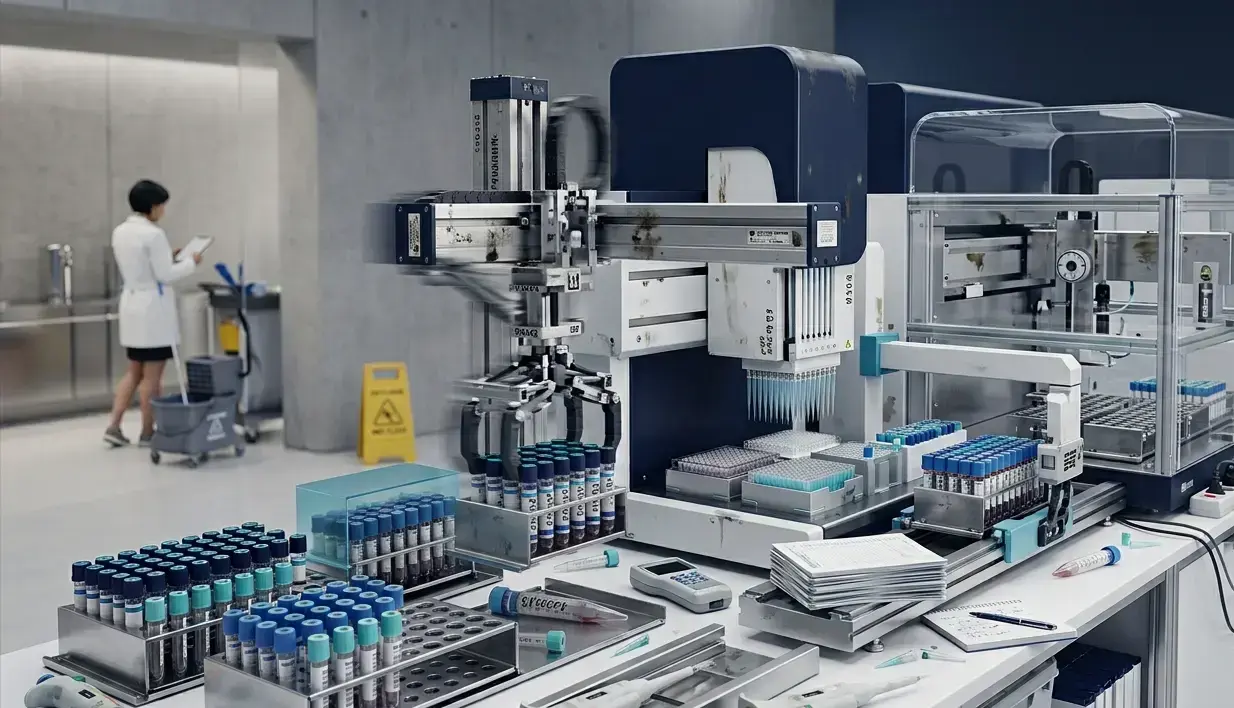
Laboratory automation brings together robotics, instrumentation, software and scientific workflows, creating demand for multidisciplinary specialists.
By LAK Consulting Group
Executive Summary
Laboratory automation is changing how diagnostic, research and analytical workflows are performed. Robotic handling, liquid-management systems, scientific instruments, software and data platforms can improve consistency, throughput and traceability while allowing skilled laboratory professionals to focus on work that requires scientific judgement.
Scaling these technologies requires a multidisciplinary workforce. Companies need mechanical, electrical, controls, robotics, embedded-software and systems engineers, together with scientists, application specialists, validation professionals, project leaders and service teams. The strongest employees understand not only the technology but also the laboratory process it is intended to support.
Recruitment is difficult because relevant expertise sits across sectors that do not always use the same language or job titles. Automation engineers may lack laboratory context, while scientific specialists may have limited experience designing or integrating industrial systems. Organisations that define the required bridge capabilities, recruit intelligently from adjacent markets and build structured domain development will be better positioned to move from promising prototypes towards reliable, scalable laboratory solutions.
Introduction
Laboratories operate through sequences of preparation, handling, measurement, analysis and documentation. Some workflows are repetitive and highly structured, while others require flexibility because samples, methods or research questions change. Automation needs to support these realities without compromising integrity or making exceptions impossible to manage.
The technology can include robotic arms, liquid handlers, conveyors, storage, incubators, readers, analysers and software that coordinates the complete process. Individual devices may perform well in isolation but still fail to create a reliable workflow if interfaces, sample identity, scheduling or error recovery are not designed coherently.
This is why laboratory automation depends on people who can work across disciplines. Engineers need to understand scientific requirements, and laboratory specialists need to engage with architecture, data and machine behaviour. Scaling requires both groups to create a shared definition of successful operation.
Why Laboratories Are Automating
Laboratories invest in automation for different reasons. Some need greater throughput or more consistent execution. Others want stronger traceability, reduced manual handling or the ability to operate complex workflows with fewer repetitive interventions. Automation can also support standardisation across sites and improve the quality of information available for operational decisions.
The objective should not be automation for its own sake. A process may contain steps that remain better suited to skilled manual work, especially where variation is high or volumes are limited. Successful programmes identify where automation creates practical scientific and operational value.
Workflow stability matters. Automating a poorly understood process can encode uncertainty into equipment and software. Teams need to examine sample variation, exception handling, quality checks and user interaction before finalising the architecture.
The business case also extends beyond labour. Reliability, utilisation, consumables, service, data quality and time to result can all influence value. Professionals who understand these factors are better able to design solutions and communicate them credibly to customers.
A Multidisciplinary Technology Environment
Laboratory automation combines technologies that are often developed by separate specialist teams. Mechanical systems move samples and consumables. Electronics and controls coordinate motion, sensing and safety. Software schedules work, manages identity and exchanges data with laboratory or enterprise platforms.
Scientific instrumentation adds another layer. The automation system may need to prepare samples for measurement, operate devices from different suppliers and interpret status or quality information. Interfaces must account for timing, environmental conditions and the physical characteristics of samples and consumables.
The resulting system needs more than individual technical excellence. Teams must agree on ownership of functions and interfaces. A scheduling decision can affect robot utilisation and sample stability, while a mechanical layout can influence contamination control, service access and software recovery.
Systems Engineering provides the structure for these trade-offs. Organisations scaling beyond a single instrument or prototype need professionals who can maintain requirements, architecture and verification across the complete workflow.
The Roles Required to Scale
The workforce depends on the product and customer environment, but several capabilities repeatedly influence successful laboratory automation.
- Systems Engineers define workflow requirements, architecture, interfaces and verification across disciplines.
- Mechanical and Mechatronics Engineers develop mechanisms, handling systems, enclosures and integration structures.
- Robotics and Controls Engineers manage motion, sequencing, sensing and safe equipment behaviour.
- Electronics and Embedded Software Engineers develop instrument control, device interfaces and real-time functionality.
- Software Engineers create scheduling, user applications, data exchange and operational tools.
- Scientists and Application Specialists translate laboratory methods into practical system requirements.
- Validation and Quality professionals ensure that processes, evidence and change are controlled appropriately.
- Project and Integration leaders coordinate internal teams, partners, customer sites and deployment.
- Service Engineers maintain equipment availability and support users after implementation.
- Product and Commercial professionals connect market needs with a scalable technical and business proposition.
Small companies may combine several responsibilities within one role, but the underlying capabilities still need ownership. Recruitment becomes risky when a broad title conceals gaps in architecture, application knowledge or validation.
Scientific Workflow Knowledge
Laboratory automation must respect the scientific process. Sample identity, preparation sequence, volumes, timing, environmental exposure and quality controls can all affect the result. Engineers need access to professionals who understand why each step exists and which variation is acceptable.
Application specialists provide this bridge. They work with customers and internal teams to translate protocols into requirements, evaluate feasibility and support demonstrations or implementation. Their credibility depends on scientific knowledge and the ability to communicate with engineers.
These professionals are difficult to recruit because the role combines laboratory experience with technical curiosity and customer interaction. Some scientists prefer research or bench work, while others have not been exposed to automated systems. Employers need to identify candidates who enjoy improving workflows and can reason systematically about exceptions.
Application capability should be involved early. If scientific input arrives only after the system architecture is fixed, teams may discover that the equipment cannot support important process details. Early collaboration reduces redesign and creates a more credible customer proposition.
Robotics, Mechatronics and Precision Handling
Laboratory samples and consumables can be small, fragile and variable. Handling systems need to position them accurately, avoid contamination and recover safely from interruptions. Mechanisms must also fit within instruments that may have strict space, environmental and service constraints.
Robotics and Mechatronics Engineers bring knowledge of motion, gripping, sensing, actuators and machine design. Their work differs from large-scale industrial robotics but shares important principles around repeatability, safety, integration and error recovery.
Candidates from industrial automation, electronics manufacturing, medical devices and precision machinery can bring relevant capability. They may need development in laboratory workflows, consumables and contamination considerations. Employers should assess the engineering problem rather than requiring identical instrument experience for every role.
Our article on the competition for Industrial Robotics Specialists describes the wider market for robotics application and integration talent. Laboratory automation companies compete within this market while offering a distinct combination of precision engineering and scientific impact.
Software, Scheduling and Data Integration
Software coordinates the laboratory workflow. It may schedule samples and instruments, manage priorities, guide users, record status and exchange information with laboratory systems. The software must also handle exceptions without losing sample identity or creating unclear process states.
Developers need to understand how their code affects physical equipment and scientific work. A software retry is not always harmless if a device has already moved or dispensed material. Error handling requires shared understanding across software, controls and application teams.
Integration is equally important. Laboratory information systems, electronic records, instruments and enterprise platforms may each own different data. Architects need to define interfaces and ensure that identifiers, results and status remain consistent.
Candidates from industrial software, medical technology and other connected-device markets may bring transferable skills. The relationship between operational processes and software is explored further in Recruiting MES and Industrial Software Professionals. Laboratory environments add scientific and data-integrity considerations that need structured onboarding.
Validation, Quality and Controlled Change
Laboratory systems may operate within regulated or quality-controlled environments. The exact requirements depend on the application, but organisations need evidence that the system performs as intended and that changes are managed appropriately.
Validation professionals connect requirements, risk and test evidence. They work with engineering and application teams to define what must be demonstrated and how results will be documented. Their contribution is strongest when validation begins with architecture rather than becoming a final documentation exercise.
Quality Engineers support design controls, suppliers, non-conformities and corrective action. They need enough technical understanding to distinguish symptoms from root causes and apply process proportionately.
Recruitment can be difficult because candidates with strong quality experience may come from larger organisations with mature systems, while growing automation companies need people who can build practical processes. Assessment should explore whether the individual understands the purpose of controls and can apply them without unnecessary bureaucracy.
From Prototype to Repeatable Product
A successful demonstration does not automatically become a scalable product. Prototypes often depend on expert intervention, flexible engineering support and components selected for availability rather than long-term manufacture. Scaling requires the organisation to address reliability, serviceability, documentation and supply.
Industrialisation Engineers help convert development work into controlled production. They collaborate with design teams on assembly, test, configuration and supplier capability. Their involvement can reveal where a technically effective design is difficult to build or support consistently.
Operations leaders need to understand the balance between standardisation and customer-specific work. Excessive customisation consumes engineering and complicates service, while an inflexible platform may not support meaningful workflow differences.
Product management has a central role in setting these boundaries. Product leaders identify which customer needs have wider market relevance and where configuration is preferable to redesign. Recruiting this capability becomes increasingly important as a company moves beyond its early customers.
Project and Integration Leadership
Laboratory automation projects connect hardware, software, applications and customer facilities. Project leaders need to coordinate these elements while maintaining visibility of technical dependencies and operational readiness.
Customer sites may require utilities, networking, space preparation, workflow redesign and user training before installation. A project that focuses only on shipping equipment can reach site with critical dependencies unresolved.
Integration leaders also manage equipment from different suppliers. Interfaces, responsibilities and support boundaries need to be clear. When a problem appears between systems, customers expect the automation provider to coordinate resolution rather than redirect them repeatedly.
Strong candidates combine technical understanding with customer and schedule discipline. They can challenge incomplete requirements, maintain decisions and communicate uncertainty without making unsupported commitments.
Service and Customer Success
Laboratory automation becomes part of the customer's operational capacity. Equipment availability, response time and application support influence whether the organisation can rely on the system. Service capability is therefore part of the product proposition.
Service Engineers need mechanical, electrical, controls and software diagnostic skills appropriate to the platform. They also require careful working practices in laboratories where samples, contamination and data are important.
Remote diagnostics can support faster response and connect regional engineers with central specialists. The architecture needs secure access, useful data and clear escalation. Remote capability does not remove the need for local field support where physical intervention is required.
Customer-success and application teams help users gain value beyond technical uptime. They support workflow adoption, training and the interpretation of performance. Recruitment should define whether these responsibilities belong to service, applications or a separate function so that customers receive consistent ownership.
Commercial Talent for Complex Laboratory Solutions
Laboratory automation sales often involves scientists, laboratory managers, information technology, procurement, quality and senior leadership. Commercial professionals need to understand the workflow, technical architecture and business case while coordinating internal specialists.
The strongest candidates qualify the complete opportunity. They examine sample volumes, methods, integration, space, validation and service rather than focusing only on the equipment. This reduces the risk of selling a platform that cannot support the intended process.
Sales cycles may include demonstrations, trials and detailed technical workshops. Commercial teams need to invest resources selectively and maintain clarity about what has been proven. An impressive demonstration should not be presented as evidence of every production condition.
Our article on recruiting commercial talent for Medical Device companies provides related insight into technical and regulated healthcare selling. Laboratory automation adds a particularly strong requirement for scientific workflow credibility.
Recruiting From Adjacent Markets
Laboratory automation companies can recruit from industrial robotics, special machinery, medical devices, analytical instrumentation, life-science tools, electronics and industrial software. Each market provides part of the required capability.
The assessment should identify what transfers and what requires development. An automation engineer may understand motion and controls but need scientific workflow exposure. A laboratory scientist may understand methods but need systems and product-development experience. A medical-device software engineer may bring validation discipline but less familiarity with high-throughput scheduling.
Structured onboarding should combine product, workflow and customer context. New employees need opportunities to observe laboratories, work with application specialists and understand how users respond when automation behaves unexpectedly.
Adjacent hiring is most successful when the team already contains enough domain authority to support transitions. Recruiting several people without relevant laboratory or product knowledge at the same time can leave the organisation unable to review decisions effectively.
Assessing Multidisciplinary Candidates
Job titles do not reveal enough in a field that combines science and engineering. Interviews should explore the candidate's actual responsibility and how they worked across disciplines.
Useful areas to assess include:
- how the candidate translated a workflow or user need into technical requirements;
- how they managed interfaces between hardware, software and applications;
- how they approached exceptions, recovery and traceability;
- what evidence they used to demonstrate performance;
- how they worked with quality, service and customer teams;
- which decisions they owned during prototype, industrialisation or deployment;
- how they communicated risk to non-specialist stakeholders.
Practical scenarios can reveal whether candidates identify missing information before proposing a solution. Strong professionals recognise that a laboratory workflow cannot be optimised from a simple list of steps; they ask about samples, variation, timing, quality and user interaction.
The recruitment process should also demonstrate collaboration. Candidates need to meet colleagues from the disciplines with which they will work. This allows both sides to assess whether the organisation genuinely supports multidisciplinary decision-making.
Developing and Retaining Capability
The external market cannot supply every combination of laboratory and automation expertise. Organisations need development pathways that allow engineers to gain scientific context and application specialists to gain system understanding.
Cross-functional project work, laboratory observation and structured mentoring help employees build this breadth. Teams should review both successful and difficult deployments so that learning informs future architecture and product decisions.
Technical career paths are important. Senior systems, software, robotics and application specialists need opportunities to gain authority without moving entirely into people management. Their expertise supports reviews, mentoring and the resolution of complex customer issues.
Retention also depends on realistic priorities. Constant customisation and urgent customer escalation can exhaust small specialist teams. Product discipline, adequate service capacity and leadership that protects engineering quality create a more sustainable environment.
Executive Perspective
Laboratory automation sits within the wider medical, laboratory and diagnostic technology market, but its talent needs also overlap with industrial automation, robotics, software and scientific instrumentation. Companies compete for professionals across all of these sectors.
Executive teams should identify which bridge capabilities create strategic advantage. Systems architecture, application knowledge, integration and product leadership often influence several programmes and should not be allowed to depend on one person.
Workforce planning needs to reflect the path from development to deployment. Scaling sales without building validation, service and industrialisation capability can create an installed base the organisation struggles to support. Hiring should follow the complete lifecycle rather than the most visible immediate need.
LAK Consulting Group supports laboratory and medical-technology organisations through technical talent acquisition, commercial talent acquisition and executive search. Market mapping can help determine where adjacent sectors offer realistic candidates for multidisciplinary roles.
Conclusion
Laboratory automation combines scientific workflows with robotics, instrumentation, software and data. Its success depends on professionals who can connect these disciplines and turn complex processes into reliable systems that users trust.
Recruitment is difficult because no single traditional talent pool contains every required capability. Companies need precise role definitions, intelligent adjacent-sector hiring and structured development that brings engineering and laboratory knowledge together.
Organisations that build balanced teams across systems, applications, validation, service and product leadership will be better positioned to move from promising technology to scalable customer value. Companies planning laboratory-automation appointments can contact LAK Consulting Group to discuss candidate availability and recruitment strategy.
Frequently Asked Questions
Which roles are most important in laboratory automation?
Key capabilities include systems engineering, robotics and mechatronics, embedded and application software, scientific applications, validation, project integration, service and product leadership.
Why is scientific workflow knowledge essential?
Automation must protect sample identity, method sequence, quality controls and exception handling. Scientific specialists explain why process steps matter and help engineers convert them into reliable requirements.
Can industrial automation professionals move into laboratory automation?
Yes. Robotics, controls, machinery and industrial-software experience can transfer well. Candidates need structured development in laboratory workflows, samples and applicable quality requirements.
Why does laboratory automation need internal systems capability?
Systems Engineers maintain architecture, interfaces and verification across hardware, software, instruments and workflows. This becomes increasingly important as products and deployments scale.
How can companies retain laboratory-automation specialists?
Meaningful technical authority, cross-disciplinary development, realistic product priorities, clear career paths and sufficient service and engineering capacity all support retention.
Discuss Your Recruitment Strategy
Every organisation faces different commercial, technical and leadership challenges. If you are planning to strengthen your team, expand into new markets or recruit for a business-critical position, we would be pleased to discuss your objectives and share our perspective on the market.
Book a ConsultationRelated Articles
Medical, Laboratory & Diagnostic Technology
Recruiting Commercial Talent for Medical Device Companies
Medical, Laboratory & Diagnostic Technology
Building Product Leadership in Diagnostic and Analytical Technologies
Electrical Engineering & Electronics