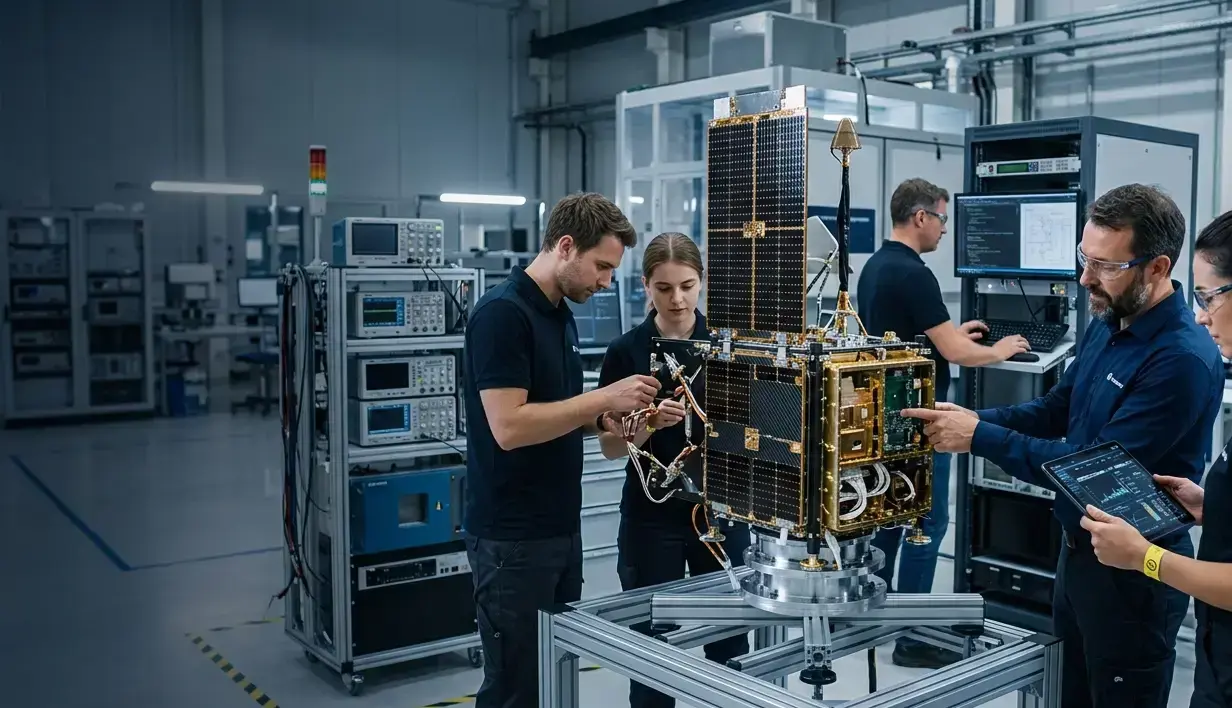
Recruiting Talent for Europe’s Expanding Commercial Space Sector
Growth in satellites, payloads, launch systems and ground infrastructure is creating competition for specialist engineering, programme and commercial talent across Europe.
By LAK Consulting Group
Executive Summary
Europe's commercial space sector brings together satellite platforms, payloads, launch services, ground systems, communications, data and specialist components. Organisations range from established aerospace groups to focused technology businesses developing new products and commercial models. Their growth depends on professionals who can translate demanding mission requirements into reliable systems and sustainable operations.
Recruitment pressure extends beyond a small group of aerospace engineers. Companies need systems, electronics, radio-frequency, embedded-software, mechanical, thermal, test and manufacturing specialists. They also require programme leaders, quality professionals, product managers and commercial teams capable of navigating long development cycles, institutional customers and international partnerships.
The strongest candidates can work across technical and organisational boundaries. Their expertise is relevant to aerospace, defence, telecommunications, electronics and other safety-critical industries, creating a competitive European talent market. Space companies that define their capability needs early, assess adjacent-sector experience intelligently and build credible technical career paths will be better positioned to scale without weakening mission discipline.
Introduction
Commercial space activity is broadening the range of organisations involved in developing and operating space technology. Satellite manufacturers, payload specialists, launch businesses, ground-segment providers and data companies each contribute to an ecosystem in which technical performance and commercial execution are closely connected.
Space products operate in environments that limit repair and demand careful control of mass, power, thermal behaviour and reliability. At the same time, commercial organisations need to manage cost, schedule and repeatability more aggressively than traditional one-off programmes may have required. Teams must preserve engineering rigour while finding ways to develop and manufacture more efficiently.
This combination creates distinctive workforce requirements. A technically strong specialist may need to operate within an evolving organisation, and an experienced commercial leader must understand why space development and qualification shape the sales cycle. Recruitment succeeds when the role reflects both the mission and the maturity of the business.
A Broad and Interconnected Space Market
The commercial space sector is not one uniform market. Satellite platforms provide power, communications, thermal control and attitude management. Payload companies develop the instruments or communications capability that create mission value. Launch providers address access to orbit, while ground systems support control, data reception and service operation.
Each segment requires specialist knowledge, but the interfaces between them are equally important. A payload must fit the platform's mass, power, thermal and data constraints. A satellite must satisfy launch conditions and communicate with ground infrastructure. Service commitments depend on the complete system performing across its lifecycle.
Commercial organisations also work with a mixture of private, institutional and governmental customers. Requirements, contracting and decision processes differ, and many programmes involve international suppliers or partners. Professionals need to understand where technical responsibility begins and ends across this network.
Recruitment strategies should therefore begin with the organisation's position in the value chain. A component manufacturer, satellite operator and launch start-up may all seek aerospace talent, but the work, risk and customer environment differ substantially.
Systems Engineering Remains Central
Space systems combine mechanical structures, electronics, embedded software, communications, power, thermal control and mission operations. Systems engineers maintain the relationship between these disciplines and the mission requirements they serve.
The role includes architecture, requirements, interfaces, trade-offs and verification planning. Systems professionals help teams understand how a decision in one subsystem affects others. They also maintain technical evidence as the design evolves and suppliers contribute their elements.
Commercial pace can increase pressure to move quickly from concept to development. Strong systems capability helps organisations make faster decisions without losing control of assumptions or interfaces. Weaknesses often appear later during integration, when correction is more costly and schedules are less flexible.
Experienced candidates are difficult to recruit because systems judgement develops through programme exposure. The broader European shortage is examined in The Competition for Aerospace Systems Engineers in Europe. Commercial space employers compete for these professionals with established aerospace programmes and adjacent safety-critical industries.
Electronics, Embedded Software and Communications
Space platforms and payloads depend heavily on electronics and software. Engineers develop onboard computing, power systems, sensors, control, communications and data handling under constraints that differ from terrestrial products. Reliability, radiation environment, energy use and thermal performance can all shape architecture.
Embedded software professionals need to understand real-time behaviour and hardware interaction. They work with limited resources, defined interfaces and verification requirements that make disciplined development essential. The same candidates may be attractive to avionics, automotive, medical and industrial technology employers.
Our article on the growing demand for Embedded Systems Engineers explores this cross-sector competition. Space organisations need to explain what makes their technical challenge distinctive while remaining realistic about development processes and location requirements.
Radio-frequency and communications expertise is similarly scarce. Professionals may work across antennas, signal processing, hardware, protocols and system performance. Employers should define whether a position requires deep component design, link-level analysis, payload responsibility or customer application support rather than searching for a generic communications engineer.
Mechanical, Thermal and Structural Expertise
Space hardware must survive launch and operate within demanding thermal and structural conditions. Mechanical engineers need to consider mass, stiffness, vibration, mechanisms, materials and manufacturability together. Thermal engineers analyse how equipment maintains acceptable operating conditions when conventional cooling approaches may not be available.
These disciplines require close collaboration with electronics, power and systems teams. Changes in packaging can affect temperature, harness design, test access and integration. The best specialists understand their own domain deeply while recognising these wider consequences.
Candidates can be recruited from aerospace, high-performance electronics, precision instrumentation and other advanced engineering sectors. Transferability depends on the responsibility involved. A senior authority may need direct space programme experience, while a design engineer with relevant simulation, test and environmental knowledge can develop product-specific capability.
Recruitment should examine evidence of taking designs through analysis, hardware build and testing. Space businesses need engineers who can connect models with physical results and respond constructively when evidence challenges the original design.
Test, Verification and Mission Assurance
Commercial pressure does not remove the need for evidence. Space hardware and software must be tested against requirements, and organisations need confidence that the complete system can perform its mission. Verification planning should begin with architecture rather than being added at the end of development.
Test engineers develop environments, procedures and instrumentation that reveal how the product behaves under relevant conditions. They need technical breadth and strong diagnostic skills because unexpected results may arise from the item, the setup or the assumptions behind the test.
Quality and mission-assurance professionals establish processes that support reliable delivery without creating unnecessary administrative burden. They work across suppliers, engineering, manufacturing and customers. Their credibility depends on understanding both the standard and the technical purpose it serves.
These roles can be difficult for growing companies to recruit because experienced candidates may associate smaller organisations with immature processes, while the company may fear that candidates from large programmes will introduce excessive bureaucracy. Assessment should focus on whether the individual can apply discipline proportionately and help the organisation mature.
Manufacturing and Industrialisation
Commercial space companies increasingly need to move from prototypes or limited builds towards more repeatable production. This transition creates demand for manufacturing engineering, supply-chain, quality and operational leadership that may not exist in a development-led organisation.
Industrialisation requires design and production teams to work together. Products must be manufacturable, testable and supported by clear configuration control. One-off engineering practices can become a constraint when volume or cadence increases.
Manufacturing professionals from electronics, medical technology, aerospace and other quality-critical environments may bring relevant capability. The strongest candidates understand how to introduce standard work and process control without ignoring the technical variability of advanced products.
Supply-chain expertise is equally important. Components and specialist processes may have limited sources or long lead times. Procurement professionals need enough technical context to understand substitution, obsolescence and supplier risk. Their decisions influence both programme schedule and product reliability.
Programme Leadership Under Technical and Commercial Pressure
Space programmes require leaders who can coordinate engineering, suppliers, customers, schedule and financial performance. They need to maintain visibility of technical dependencies while ensuring that decisions are made at the appropriate level.
Commercial organisations often manage several programmes or product developments with overlapping specialists. Programme leaders must recognise where commitments exceed actual engineering or test capacity. A schedule that assumes unlimited access to key experts is not a credible delivery plan.
Customer communication is part of the role. Leaders need to present progress, uncertainty and recovery actions clearly without concealing risk or creating unnecessary alarm. This capability is particularly valuable when customers and partners are distributed internationally.
Recruitment should examine the scale and maturity of programmes candidates have led. A person accustomed to a large established organisation may expect functions and processes that a growing space company has not yet built. Someone from a smaller business may bring adaptability but less experience with complex governance. The right profile depends on the organisation's current stage.
Commercial and Business-Development Talent
Space sales and business development can involve institutional programmes, commercial operators, strategic partnerships and technical services. Opportunities often require early technical engagement and can develop through long decision cycles. Commercial professionals need to understand both the customer mission and the supplier's delivery capability.
Technical credibility helps identify where the product creates real value. A business-development leader should recognise the difference between general market interest and an opportunity with a defined requirement, budget and decision path. They also need to coordinate internal engineering resources selectively.
Partnership development can be as important as direct sales. Space companies may need complementary technology, launch access, distribution or integration partners. Strong candidates understand how responsibilities, intellectual property and commercial value are shared rather than treating every partnership announcement as progress.
Recruitment should assess whether candidates have created opportunities or primarily managed existing institutional relationships. Both backgrounds can be useful, but an expanding commercial company may need evidence of building a market and shaping a proposition under uncertainty.
Product Management in Commercial Space
Product management helps space companies balance customer requirements with a coherent technical roadmap. Without this capability, organisations can accumulate custom developments that consume engineering capacity and weaken repeatability.
Product leaders need to understand missions, users, technology and business economics. They work with systems engineering to define boundaries and with commercial teams to evaluate which requirements have wider market relevance. They also need the authority to decline work that would divert the product without sufficient value.
Candidates may come from engineering, programme or commercial backgrounds. The strongest individuals can move between technical detail and market priorities without treating either as secondary. They use evidence from customers and delivery rather than relying on abstract product language.
The role becomes more important as companies move from funded development towards repeatable revenue. Recruitment should clarify whether the product manager owns strategy, requirements, commercial packaging or all three, and how that authority relates to founders and technical leaders.
Regulation, Security and International Collaboration
Space technology can involve export controls, security requirements, licensing and restrictions on technical information. The exact obligations depend on products, customers and jurisdictions, but employees need to understand the boundaries relevant to their work.
Recruitment may therefore involve nationality, clearance or location considerations for specific positions. Employers should define these accurately and avoid applying broad restrictions where they are not required. Unnecessary limitations reduce an already specialised talent pool.
International collaboration also requires disciplined handling of interfaces and information. Partners may work under different legal, cultural and technical frameworks. Programme, commercial and engineering leaders need to know which decisions can be shared and how responsibilities are documented.
Candidates should be informed early about genuine constraints. A role that appears globally collaborative may in practice involve secure-site presence or restricted programmes. Transparency supports better decisions and retention.
Recruiting Across Established and Emerging Employers
Established aerospace groups provide deep programme experience, specialised processes and mature technical career paths. Growing space companies offer broader responsibility, faster decisions and closer connection between engineering and business outcomes. Candidates evaluate these environments differently.
Smaller employers sometimes assume that mission excitement will compensate for unclear roles or unsustainable workload. Experienced professionals still assess leadership, funding credibility, tools and development discipline. They want to understand whether the organisation can convert ambition into a deliverable programme.
Candidates moving from a large company may need support adapting to fewer specialist functions and greater individual ownership. The recruitment process should test their willingness to work directly on problems and build processes, not only operate within them.
Professionals moving in the other direction may bring entrepreneurial judgement and broad capability. Established employers should recognise this experience even where previous titles or team sizes differ from conventional corporate structures.
Adjacent-Sector Talent
Space organisations can broaden recruitment through electronics, telecommunications, automotive, rail, medical technology, energy and precision manufacturing. These markets develop engineers and leaders experienced in complex systems, embedded technology, verification and controlled production.
Transferability needs disciplined assessment. Candidates should demonstrate relevant engineering principles and an ability to work within rigorous requirements. The organisation must then provide onboarding in the space environment, mission context and applicable standards.
Some positions require direct heritage. Senior system authorities, mission-assurance leaders or specialists making high-consequence decisions may need prior space programme responsibility. Other roles can be filled successfully from adjacent sectors when experienced space colleagues remain available for review and mentoring.
The objective is not to lower the threshold. It is to distinguish scarce space-specific judgement from capabilities that can be brought into the sector and developed.
Building and Retaining Space Capability
External recruitment should be combined with internal development. Graduate engineers, researchers and specialists from adjacent industries need opportunities to gain programme responsibility under experienced supervision. Training alone cannot replace involvement in reviews, hardware, tests and mission decisions.
Technical career paths are important because senior specialists may want greater authority without becoming people managers. Principal Engineer, technical fellow and subsystem authority roles can preserve expertise and create visible progression.
Retention depends on the quality of work and leadership. Space professionals value meaningful missions, but they also need realistic priorities, appropriate tools and decisions that respect engineering evidence. Constant changes without clear rationale can weaken both delivery and trust.
Knowledge management matters because programmes can depend heavily on a few individuals. Requirements rationale, design decisions and test learning should be captured in usable form. Mentoring and review processes help turn personal experience into organisational capability.
Scaling Leadership Teams
Founders and early technical leaders often carry product, customer and organisational responsibility simultaneously. As the company grows, these responsibilities need clearer ownership. Recruitment may be required across engineering leadership, programme management, operations, quality and commercial functions.
The timing is delicate. Hiring senior leaders too early can introduce structure that the organisation cannot support, while waiting too long leaves decisions concentrated and teams without sufficient direction. The trigger should be the complexity and consequence of decisions rather than headcount alone.
Leadership candidates need evidence of operating at the relevant scale. They should be able to build processes proportionately, develop teams and work constructively with founders or established technical authorities. Space experience is important, but organisational fit and execution capability also determine success.
For roles with broad technical or commercial influence, executive search can provide access to leaders who are not actively applying and allow assessment across both sector credibility and growth-stage capability.
Executive Perspective
Europe's commercial space companies operate within a wider [aerospace, space and defence] talent market that also serves established aircraft, defence and safety-critical technology programmes. Their opportunity is compelling, but access to experienced people cannot be assumed.
Workforce planning should be connected to programme awards, product roadmaps and planned production. Systems, test, manufacturing and programme capability often need to be built before commercial milestones create visible revenue. Waiting until delivery pressure arrives reduces the available options.
Employers should identify where direct space experience is essential and where adjacent-sector recruitment can expand the pool. They should also define the work precisely. Strong candidates respond to clear technical responsibility and organisational purpose, not generic claims about disrupting space.
Companies expanding across borders should consider how local teams connect with central engineering and programme authority. Our article on international expansion and hiring the right local team provides related guidance for building credible regional capability.
Conclusion
Commercial space brings together advanced technology, complex programmes and evolving business models. Organisations need specialists across systems, electronics, software, mechanical engineering, test, manufacturing and quality, supported by programme and commercial leaders who understand the realities of the sector.
Recruitment is challenging because the most valuable capabilities take time to develop and are relevant across several European industries. Employers can improve access by defining roles accurately, considering adjacent sectors and creating structured pathways for technical development.
Companies that build capability ahead of programme pressure will be better positioned to deliver reliable technology and grow sustainably. Space organisations planning specialist or leadership appointments can contact LAK Consulting Group to discuss candidate availability and recruitment strategy across Europe.
Frequently Asked Questions
Which roles are most difficult to recruit in commercial space?
Pressure is strong across systems engineering, electronics, embedded software, radio-frequency engineering, test, mission assurance, programme leadership and technically credible commercial roles.
Can space companies recruit engineers from other industries?
Yes. Electronics, telecommunications, automotive, rail, medical technology and other safety-critical sectors can provide transferable capability. Structured onboarding is needed for mission context, standards and space-specific constraints.
Why is systems engineering important in commercial space?
It connects mission requirements with architecture, interfaces and verification across mechanical, electronic and software disciplines. Strong systems capability helps organisations move quickly without losing technical coherence.
What attracts experienced candidates to commercial space companies?
Meaningful technical responsibility, credible missions, strong leadership, appropriate tools, career progression and evidence that the organisation can fund and deliver its plans all influence candidate decisions.
How can growing space companies retain specialist expertise?
They can provide technical career paths, sustainable priorities, mentoring, clear decision authority and disciplined capture of programme knowledge.
Discuss Your Recruitment Strategy
Every organisation faces different commercial, technical and leadership challenges. If you are planning to strengthen your team, expand into new markets or recruit for a business-critical position, we would be pleased to discuss your objectives and share our perspective on the market.
Book a Consultation