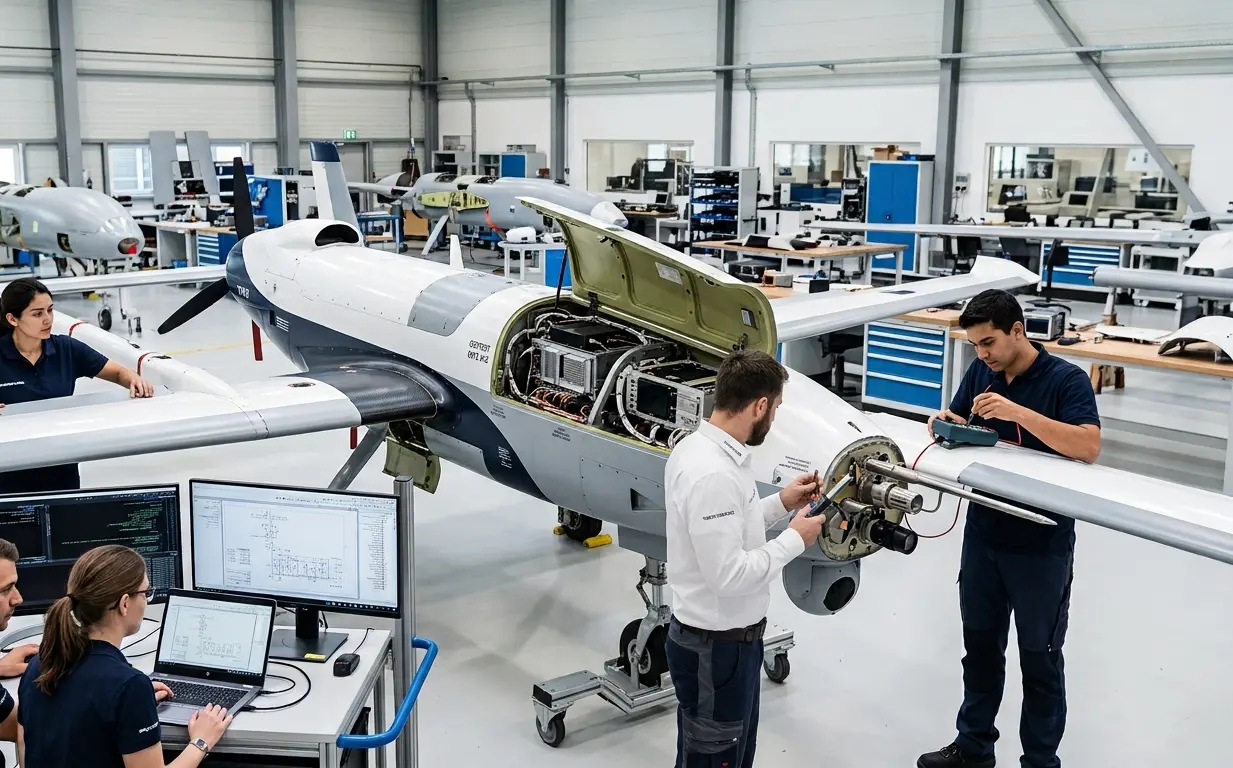
Recruiting for Autonomous Aircraft and Uncrewed Systems
Autonomous aircraft and uncrewed platforms require multidisciplinary talent across flight controls, embedded software, communications, sensors and certification.
By LAK Consulting Group
Executive Summary
Autonomous aircraft and uncrewed systems combine aerodynamics, propulsion, flight controls, embedded software, sensing, communications and mission capability within a platform that must behave predictably in complex environments. Recruiting for these programmes is difficult because success depends not only on excellence within each discipline, but also on the ability to integrate them into a safe and verifiable system.
The strongest candidates are in demand across aerospace, defence, robotics, automotive technology, communications and advanced electronics. Their experience cannot be assessed reliably through job titles alone. A Flight Controls Engineer may have worked on algorithm development, software implementation, test operations or certification evidence, while an autonomy specialist may have built impressive demonstrations without taking a system through rigorous assurance or operational deployment.
Employers should define the platform, operating environment, maturity stage and certification ambition before beginning a search. They need to distinguish specialist depth from system-level responsibility and build complementary teams rather than look for one individual who covers every technical layer. Recruitment becomes more effective when candidates are assessed through the decisions, interfaces, tests and evidence they have owned across a real development lifecycle.
Introduction
Autonomy in aviation is not a single technology. It is the coordinated behaviour of sensors, software, flight-control systems, communications, navigation and physical aircraft. Decisions must be made within tight limits for timing, energy, weight, environmental conditions and system reliability. A weakness at one interface can undermine performance across the platform.
Uncrewed systems also serve very different missions. Some operate within controlled industrial environments or direct human supervision. Others must navigate more complex airspace, maintain communications over distance or continue safely when information is incomplete. The technical and assurance demands therefore depend heavily on the intended operation.
This makes talent strategy a systems question. Organisations need deep specialists, but they also need people who understand how their work affects the aircraft as a whole. The recruitment challenge is to secure both without making the role so broad that no credible candidate can satisfy it.
Why the Talent Requirement Is Expanding
Uncrewed platforms are being developed for inspection, monitoring, logistics, mapping, research, public-service and defence applications. Each application creates different expectations for endurance, payload, navigation, data transfer and human oversight. As programmes move from demonstrations towards repeatable operations, organisations need talent that can convert technical capability into dependable products.
This transition increases demand for systems engineering, verification, safety and certification expertise alongside the more visible fields of robotics and artificial intelligence. A prototype can be improved rapidly in a controlled test environment. An operational aircraft must behave consistently across environmental variation, degraded conditions and foreseeable failures.
Companies therefore compete for professionals who combine innovation with engineering discipline. These candidates are valuable because they can move a programme forward without separating performance from safety, supportability and regulatory acceptance.
A Multidisciplinary Engineering Challenge
An autonomous platform brings together structures, aerodynamics, propulsion, electrical power, avionics, flight controls, embedded computing, communications, sensors and ground systems. Payload and mission software add further dependencies. Changes in one area can influence several others.
A more powerful computer may improve perception but increase weight, heat and energy consumption. A new sensor can affect mechanical integration, data processing and electromagnetic compatibility. Communications choices influence antenna design, operating range, cybersecurity and procedures for degraded links.
This interdependence makes interface ownership critical. Employers need engineers who can define requirements across boundaries, identify unintended consequences and communicate with specialists outside their original discipline. The wider European competition for this capability is examined in The Competition for Aerospace Systems Engineers in Europe.
Flight Controls and Vehicle Dynamics
Flight Controls Engineers translate an understanding of aircraft dynamics into stable and predictable behaviour. Their work may include modelling, control-law design, simulation, tuning, implementation and flight-test support. Autonomous platforms can introduce additional complexity through unconventional configurations, changing payloads or transitions between flight modes.
Relevant candidates need more than familiarity with control theory. They should understand model limitations, sensor behaviour, actuator constraints and the consequences of software implementation. Experience of hardware-in-the-loop testing, flight-data analysis and fault response is often highly valuable.
Assessment should establish what the candidate actually owned. Developing an algorithm in simulation differs from releasing control software, planning flight tests or supporting formal verification. Each can be relevant, but the distinction must be clear.
Embedded Software and Real-Time Systems
Embedded software executes many of the decisions on which safe flight depends. It must handle inputs, control outputs and communications within predictable timing constraints while operating on limited computing resources. Engineers may also need to manage redundancy, degraded modes and secure updates.
Recruitment is difficult because embedded roles vary widely. Experience in connected consumer devices does not automatically prepare someone for safety-critical real-time behaviour, while traditional avionics experience may not include modern autonomy frameworks or high-performance onboard processing.
Employers should evaluate the constraints a candidate has worked under, the interfaces they owned and how their software was tested. The Growing Demand for Embedded Systems Engineers explores this broader competition for professionals who can connect software with physical products.
Autonomy and Mission Software
Autonomy specialists develop the capabilities that allow a platform to perceive its environment, plan actions and respond to changing conditions. Relevant work can include localisation, path planning, decision logic, obstacle avoidance, mission management and coordination between vehicles.
The role is sometimes defined too heavily around algorithms. Operational autonomy also depends on requirements, data quality, computing limits and the behaviour of surrounding systems. A method that performs well in a research dataset may be unsuitable when environmental conditions, sensor availability or timing constraints change.
Strong candidates understand uncertainty and operational boundaries. They can explain how a capability fails, how performance was validated and when the system should defer to a human or enter a safer state. This judgement is as important as familiarity with a particular framework.
Sensors, Perception and Navigation
Autonomous aircraft may combine satellite navigation, inertial measurement, cameras, radar, lidar, air-data systems and other mission-specific sensors. Each source has strengths, limitations and failure modes. Reliable operation depends on understanding how these sources interact rather than assuming that more data always improves performance.
Sensor-fusion and perception specialists need knowledge of calibration, synchronisation, estimation and environmental effects. Lighting, weather, vibration, electromagnetic interference and physical placement can all alter real-world results. The most effective engineers work closely with hardware, software and test teams.
Candidates should be asked how they diagnosed inconsistent sensor behaviour, validated performance outside ideal conditions and managed degraded information. Evidence from deployed robotics, automotive sensing, navigation or specialised instrumentation may transfer well when the physical and assurance challenges are comparable.
Communications and Command Links
Communications are essential to many uncrewed operations. The platform may need command and control, telemetry, payload-data transfer and coordination with ground infrastructure or other vehicles. Range, bandwidth, latency, interference, regulation and security all influence architecture.
Recruitment can draw from aerospace, defence, telecommunications and industrial wireless markets, but employers must define what expertise is genuinely required. Radio-frequency design, communication protocols, network architecture and operational link management are distinct capabilities.
Engineers also need to consider what happens when connectivity degrades or disappears. Autonomous behaviour and communications cannot be designed independently because loss-of-link responses form part of the operational safety concept.
Electrical Power, Propulsion and Thermal Constraints
Every onboard capability competes for mass, space, power and cooling. Sensors and processors may increase mission performance while reducing endurance or creating thermal challenges. Electric and hybrid platforms add further interactions between batteries, power electronics, propulsion control and aircraft behaviour.
These constraints create demand for engineers who can optimise at platform level rather than within isolated components. Relevant experience may come from aerospace, automotive electrification, advanced robotics or other high-performance applications.
The growing competition for power-conversion expertise is discussed in Why Power Electronics Engineers Have Become Critical to Electrification. For autonomous aircraft employers, the important question is whether a candidate can apply that expertise within aviation-specific weight, reliability and assurance constraints.
Safety Engineering and Assurance
Autonomous operation changes how hazards are identified and controlled. Functions traditionally performed by a pilot may be distributed across onboard systems, remote operators and operational procedures. The organisation must explain how failures are detected, contained and managed.
Safety Engineers help translate the operating concept into requirements, analyses and verification evidence. They work across system architecture, hardware, software, human factors and operations. Their influence is greatest when they are involved early rather than asked to justify a completed design.
Recruitment should look for candidates who can engage constructively with development teams. The strongest safety professionals do not merely administer compliance documents; they improve engineering decisions by revealing assumptions, dependencies and failure paths.
Certification and Regulatory Capability
The route to approval depends on the aircraft, operation, jurisdiction and risk. Organisations need people who can interpret applicable requirements, develop a credible certification strategy and maintain productive engagement with relevant authorities and partners.
Certification experience is particularly scarce because it develops through sustained exposure to real programmes. Candidates must understand how requirements, design decisions, configuration control, verification and traceability combine into an acceptable body of evidence.
Companies should avoid treating certification as a final-stage activity. Hiring assurance capability too late can expose gaps that are expensive to correct. Early integration enables the development approach and evidence plan to mature together.
Verification, Simulation and Flight Test
Autonomous systems require layered verification. Software components, integrated subsystems, complete vehicles and operational scenarios all need appropriate testing. Simulation can expose the platform to large numbers of conditions, but physical tests remain essential for understanding sensors, environments and real hardware behaviour.
Test professionals must design evidence rather than simply execute scripts. They should understand requirements, coverage, instrumentation, configuration and anomaly investigation. Flight-test engineers also need disciplined operational judgement because learning objectives must be balanced with vehicle and airspace risk.
Candidates who have connected simulation, hardware-in-the-loop facilities, ground testing and flight data can be especially valuable. They help programmes build confidence progressively instead of relying on dramatic demonstrations that reveal little about repeatability.
Cybersecurity and Resilience
Connected aircraft introduce potential vulnerabilities across communication links, onboard computing, ground systems, supply chains and update mechanisms. Cybersecurity must therefore be considered alongside safety and operational resilience.
Relevant specialists need to understand embedded and operational constraints. Security measures that consume excessive bandwidth, computing capacity or maintenance effort may be difficult to sustain. Conversely, convenience cannot justify weak access control or unmanaged software dependencies.
Employers should seek candidates who can work across disciplines and integrate security requirements into architecture and lifecycle processes. Experience from aerospace, defence, automotive or critical infrastructure may be relevant when accompanied by a practical understanding of physical systems.
Human Oversight and Ground Operations
Uncrewed does not mean human-free. Remote pilots, mission operators, maintainers and fleet supervisors remain part of the system. Their responsibilities, information and workload change as autonomy increases.
Human-factors and operations specialists help define how people supervise the platform, respond to abnormal conditions and coordinate multiple vehicles. Ground-control interfaces must present the right information without creating unnecessary workload or ambiguity.
Candidates should understand the operational context rather than treat the ground station as an isolated software interface. Experience of training, procedures and real missions can provide insight that is difficult to develop solely within a laboratory.
Why Job Titles Are Unreliable
The emerging nature of the sector produces inconsistent titles. An Autonomy Engineer may specialise in planning algorithms, systems integration, embedded implementation or test. A Guidance, Navigation and Control Engineer may focus on estimation, control laws or complete vehicle behaviour. Systems Engineers can range from requirements specialists to technical architects.
Searches built around titles alone will miss relevant talent and create false matches. Employers should describe the decisions, interfaces and development stage that define the role. They should then map candidates across aerospace and selected adjacent sectors based on comparable work.
Structured talent mapping can help organisations understand where scarce capability sits, how competitors structure their teams and which adjacent markets contain transferable experience.
Assessing Multidisciplinary Candidates
Assessment should explore a small number of programmes in depth. Candidates should explain the mission, system boundary, personal responsibility, critical interfaces and evidence used to make decisions. Interviewers should probe where assumptions failed and how the team responded.
For specialist roles, technical peers should evaluate depth while cross-functional interviewers assess integration and communication. For systems and leadership positions, candidates should demonstrate how they balanced performance, schedule, safety and certification rather than presenting only a successful outcome.
A bounded technical scenario can reveal reasoning. Strong candidates clarify the operating conditions and risks before offering a solution, identify the disciplines that need to participate and describe how uncertainty would be reduced through analysis and test.
Recruiting from Adjacent Industries
The direct aerospace talent pool may not satisfy every programme’s needs. Automotive autonomy, robotics, communications, advanced electronics and safety-critical industrial systems can provide relevant experience. The value of that experience depends on which constraints transfer.
An automotive perception specialist may bring mature sensing and validation knowledge but need to adapt to aviation weight, environment and certification demands. A robotics engineer may understand rapid integration but have limited experience of formal assurance. An avionics engineer may bring rigorous lifecycle discipline while needing exposure to modern autonomy methods.
Employers should identify these development gaps openly and provide credible onboarding. Adjacent recruitment succeeds when the organisation values transferable capability without underestimating the aviation context.
Building the Team Around the Platform
No single engineer can provide deep expertise across aerodynamics, controls, autonomy, communications, sensors, software, safety and certification. Attempts to recruit a universal autonomous-aircraft expert usually produce unrealistic specifications and delayed decisions.
The team should be designed around architecture and interfaces. Leaders need to determine which capabilities are core intellectual property, which require enduring internal ownership and where partners can contribute effectively. Clear technical authority prevents gaps from forming between functions.
The answer will change as the programme matures. Early development may emphasise architecture and rapid learning, while later stages require greater depth in verification, configuration, production and operational support. Workforce planning should anticipate these transitions.
Retaining Scarce Aerospace Talent
Specialists are attracted by ambitious technology, but they remain where programmes demonstrate credible direction and engineering standards. Repeated priority changes, unclear ownership or insufficient test resources can undermine retention even when the mission is compelling.
Technical career paths should allow experts to gain influence without leaving engineering. Access to facilities, mentoring and cross-disciplinary learning helps candidates build the system understanding that autonomous programmes require.
Leaders should also communicate how the technology will move from demonstration to operation. Professionals who care about real-world impact want to see a plausible route through verification, certification, production and customer use.
Executive Perspective
Before opening a search, leaders should define the platform, operating concept and programme stage. They should establish which technical decisions the appointment will own, which interfaces are most critical and what evidence must be delivered during the first year.
The recruitment process should distinguish innovative experimentation from dependable product development while valuing both appropriately. Candidates who can bridge these worlds are scarce, but precise assessment and a credible mandate improve access to them.
LAK Consulting Group supports technical and business-critical recruitment across aerospace, space and defence, including specialist engineering and programme leadership appointments.
Conclusion
Autonomous aircraft and uncrewed systems demand more than expertise in algorithms or airframes. They require flight controls, embedded software, sensors, communications, power systems, safety engineering, certification and operations to function as one coherent platform.
Recruitment is challenging because relevant capability is distributed across industries and hidden behind inconsistent titles. Companies should define roles through system responsibility, interfaces and lifecycle evidence, then assess what candidates have actually designed, integrated, tested and supported.
The strongest organisations will build complementary teams and involve assurance expertise from the beginning. By combining specialist depth with system-level ownership, they can develop autonomous platforms that are not only innovative, but also dependable, verifiable and ready for sustained operation.
Frequently Asked Questions
Which specialists are required for autonomous aircraft programmes?
Typical needs include Systems Engineers, Flight Controls Engineers, embedded software developers, autonomy and perception specialists, sensor-fusion engineers, communications experts, safety and certification professionals, verification engineers and flight-test personnel. The balance depends on the platform and programme stage.
Why are autonomous-aircraft candidates difficult to find?
The work combines several scarce disciplines, and many candidates are also relevant to defence, robotics, automotive technology, communications and advanced electronics. Job titles are inconsistent, so employers must assess actual system responsibility and delivery experience.
Can aerospace companies recruit autonomy talent from automotive or robotics businesses?
Yes, when the candidate’s experience addresses comparable sensing, real-time, integration or validation problems. Employers must still evaluate gaps in aviation safety, environmental constraints, certification and operational practice.
When should certification specialists join an autonomous-aircraft programme?
They should contribute early enough to influence architecture, requirements, development processes and the evidence plan. Introducing certification only after major design decisions have been made can create costly rework.
How should employers assess autonomous-systems candidates?
They should examine real programmes in depth, including the mission, candidate’s ownership, critical interfaces, failure conditions, test approach and delivered evidence. To discuss a specific search, contact LAK Consulting Group.
Discuss Your Recruitment Strategy
Every organisation faces different commercial, technical and leadership challenges. If you are planning to strengthen your team, expand into new markets or recruit for a business-critical position, we would be pleased to discuss your objectives and share our perspective on the market.
Book a ConsultationRelated Articles