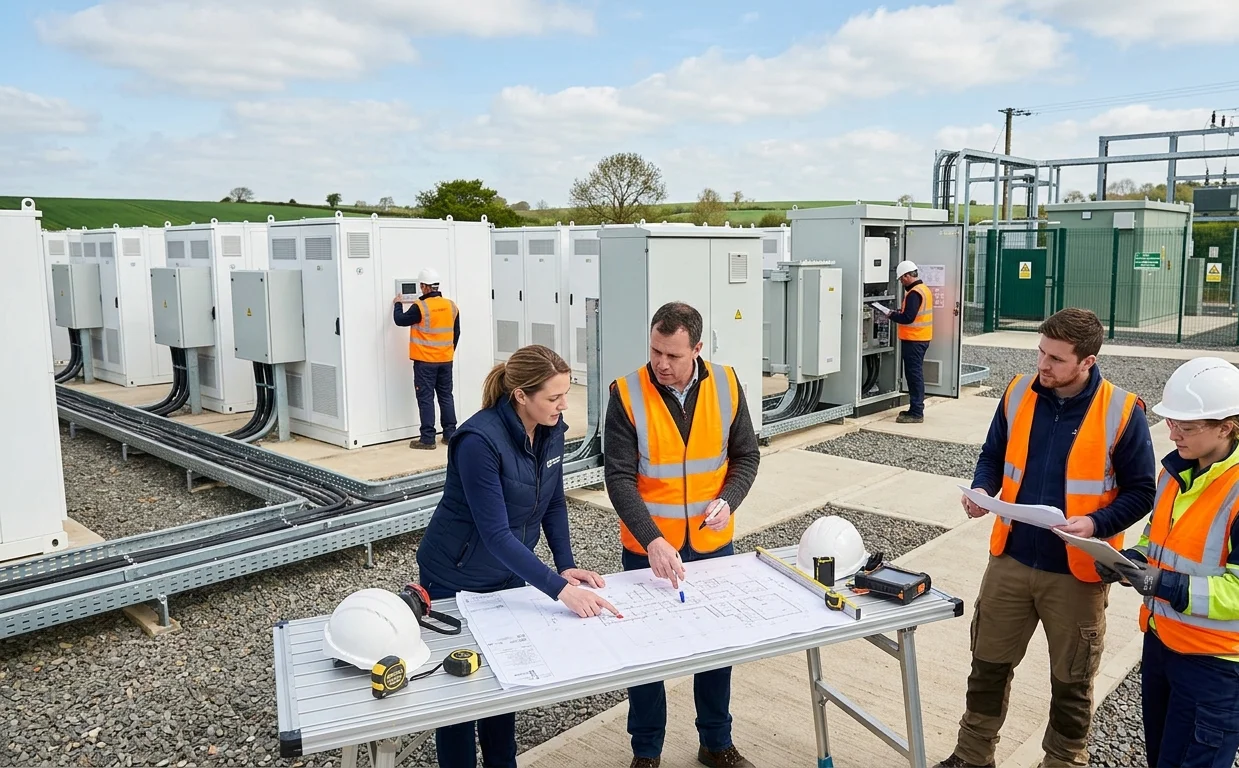
The People Behind Europe’s Energy-Storage Expansion
Battery-storage projects depend on engineering, project, procurement and operational talent to move from development into reliable operation.
By LAK Consulting Group
Executive Summary
Battery-energy-storage projects are often described through capacity, technology and investment. Their success depends equally on the people who develop sites, secure grid access, define the technical solution, manage suppliers, deliver construction, commission safely and operate assets throughout their life.
These capabilities are difficult to assemble because the sector brings together disciplines that have historically sat in different industries. Grid and power-system engineers, project developers, electrical designers, procurement specialists, construction managers, control-system professionals, asset managers and commercial optimisation teams are all needed at different stages. Many are also relevant to renewables, transmission, conventional power, industrial electrification and large infrastructure projects.
The strongest employers treat talent as a delivery constraint rather than a downstream HR issue. They define the asset and operating model before recruiting, make accountabilities clear across the project lifecycle and build teams with complementary expertise. Organisations that invest early in technical authority, supplier management, commissioning and operations are better positioned to convert development pipelines into safe, reliable and commercially effective storage assets.
Introduction
Energy storage is becoming an increasingly important part of modern electricity systems. Battery projects can support flexibility, help manage variation in generation and demand, and provide services that depend on reliable connection, control and operating discipline. Yet a storage project is not simply a collection of battery containers installed on a site.
It is a complex infrastructure asset. Development decisions influence grid connection, construction cost, safety, performance and future operations. Technical choices about cells, inverters, transformers, control systems, cooling and fire protection affect procurement, commissioning, maintenance and commercial availability. A project that reaches financial close without a clear delivery and operating model can carry risk into every subsequent stage.
The people behind the project therefore matter as much as the hardware. They provide the judgement that connects a promising development opportunity with an asset that can be built, energised and operated as intended.
Why the Talent Challenge Is Broadening
Early storage teams were often concentrated around development, finance and a small number of technical specialists. As portfolios grow and projects move into construction and operation, the talent requirement broadens. Companies need more delivery discipline, deeper grid expertise, robust procurement, operational readiness and asset-management capability.
This shift is significant because many of the required skills are not unique to storage. Grid-connection engineers are also needed by renewable developers, network businesses and industrial users. High-voltage and commissioning professionals can work across substations, generation and process industries. Project Managers with strong infrastructure experience are relevant to several capital-intensive markets.
Competition is therefore based on the quality of the role as well as remuneration. Candidates assess the technical credibility of the organisation, the maturity of its pipeline, the authority attached to the role and whether leaders understand the practical work required after an investment decision has been made.
Development and Site Origination
The first talent challenge is identifying sites that can become viable assets. Development professionals assess land, planning, grid opportunities, environmental requirements, community considerations, commercial structure and likely delivery constraints. Their work creates the initial business case, but it must be informed by technical reality.
In storage, a development concept can change materially once grid configuration, site constraints, equipment layout or operating requirements are examined in detail. Strong developers work closely with technical colleagues early enough to expose assumptions before they become commitments.
Employers should assess candidates for evidence of progressing complex infrastructure opportunities rather than simply acquiring sites. Relevant experience includes coordinating land and grid processes, managing external advisers, understanding development risk and aligning stakeholders around a viable sequence of decisions.
Grid Connection and Power-System Expertise
Grid connection is central to storage value and delivery. The project must connect safely and operate in a way that meets relevant technical requirements. This can involve network studies, protection philosophy, substation design, reactive-power considerations, control interaction and coordination with the network operator.
The required expertise spans development and delivery. Early advice helps assess connection feasibility and programme risk. Later work shapes the detailed design, commissioning plan and operating arrangements. A weak handover between those stages can create costly redesign or delay.
Companies should distinguish between general electrical competence and deep power-system understanding. The most valuable candidates can interpret network requirements, challenge design assumptions and communicate effectively with transmission or distribution stakeholders. Recruiting Leadership for Grid and Energy-Infrastructure Growth examines the wider leadership challenge created by this expanding infrastructure environment.
Technical Design Authority
Battery storage combines several technical layers: cells and modules, battery-management systems, power-conversion systems, transformers, medium- and high-voltage equipment, cooling, fire protection, civil works, controls and communications. The technical design authority ensures that these layers form one coherent asset.
This role is not merely a specification writer. Technical leaders must make trade-offs between performance, availability, safety, cost, maintainability and delivery risk. They need to define interfaces between suppliers, ensure that requirements remain consistent and preserve an audit trail of critical decisions.
Recruitment should focus on relevant ownership. A candidate may have worked on equipment design, electrical integration, owner’s engineering or EPC delivery. The important question is what technical decisions they made, how they resolved interfaces and whether they understand the operational consequences of their choices.
Battery and Power-Conversion Expertise
Battery technology and power conversion are fundamental, but their importance lies in application. Cell characteristics, thermal behaviour, degradation, inverter capability and control performance must be evaluated against the intended use of the asset. A technically impressive component may not produce the right lifecycle or availability outcome for the project.
Power-electronics professionals are especially valuable because they understand the conversion and control systems that connect storage to the grid. Their experience can transfer from renewable energy, electric mobility, industrial drives or other electrification markets, but employers should assess the extent to which candidates have worked with utility-scale requirements and grid interaction.
Why Power Electronics Engineers Have Become Critical to Electrification explores why this specialist market has become more competitive. Storage employers need to combine this depth with system integration and asset-lifecycle judgement.
Safety Engineering and Risk Management
Safety must be designed into the project from the start. Storage assets require consideration of battery behaviour, thermal management, detection, suppression or mitigation measures, site layout, access, emergency response and operating procedures. Responsibilities extend across the owner, designers, equipment suppliers, contractors, insurers and emergency stakeholders.
Safety specialists need to be able to influence decisions early. If they are engaged only at the end of design, options may be limited and the team may be forced to react to risks that could have been reduced through architecture, layout or equipment choices.
Strong candidates combine technical diligence with practical communication. They can explain risk to senior leaders, engage suppliers and work constructively with project teams. Assessment should explore how a candidate has influenced real design or operational decisions, not simply their familiarity with standards and documentation.
Project Management and Delivery Leadership
Storage projects require Project Managers who can coordinate engineering, procurement, construction, commissioning, permits, grid interfaces and commercial commitments. The role involves more than maintaining a programme. Delivery leaders need to identify dependencies, make trade-offs and escalate issues while they are still manageable.
The most useful experience may come from several infrastructure sectors. Renewable projects, substations, industrial electrification, power generation and complex process facilities can all provide relevant exposure. The transferability depends on the scale, contractual model, technical interfaces and operating constraints involved.
Employers should assess candidates through project evidence. How did they manage design changes? What did they do when a supplier missed a key milestone? How did they coordinate grid, civil and electrical work? Which risks did they identify before they affected the critical path?
Procurement as a Strategic Capability
Procurement in battery storage is not a transactional purchasing function. The team must understand equipment capability, supplier maturity, contractual interfaces, warranties, logistics, spares, service obligations and the implications of technical change. Commercial terms can affect both the initial business case and long-term asset performance.
Strategic Procurement professionals work closely with engineering and project delivery. They need enough technical literacy to challenge specifications and evaluate alternatives without undermining safety or quality. They also need market insight to understand supplier capacity, delivery risk and appropriate risk allocation.
This requirement resembles the changing role of procurement in other industrial markets. Why Machinery Manufacturers Need Stronger Strategic Procurement Teams examines how supply risk and technical complexity have transformed the function. In storage, the same discipline must be connected to equipment performance and operational support.
Supplier and Contract Management
Large storage assets depend on a network of equipment and service providers. Interfaces between battery-system suppliers, power-conversion providers, civil contractors, balance-of-plant contractors, grid specialists and software vendors need active management. Ambiguity can produce gaps in responsibility at precisely the point a problem emerges.
Contract Managers help protect the project through clear obligations, change control, evidence and escalation. Their work is most effective when they understand the technical and programme context rather than operating solely after a dispute has developed.
Candidates should demonstrate how they have managed complex interfaces, protected critical rights and maintained constructive supplier relationships. A confrontational approach can be as damaging as excessive deference when the project depends on coordinated delivery.
Construction Management and Site Execution
Construction transforms the design into a physical asset. Site teams coordinate civil works, electrical installation, equipment delivery, quality control, safety, logistics and changing conditions. Storage projects can involve concentrated installation activity followed by time-sensitive commissioning and grid energisation.
Construction Managers need practical authority and clear technical support. They must understand the quality standards that cannot be compromised and the interfaces that require close coordination. Experience in high-voltage work, large electrical installations or complex energy projects can be particularly relevant.
The recruitment brief should define site responsibilities accurately. A person who has managed general construction may not have the electrical or control-system depth required to coordinate a storage project. Equally, a strong Electrical Engineer may need support in broader site leadership and contractor management.
Commissioning and Grid Energisation
Commissioning is the bridge between construction and operations. It verifies that systems have been installed correctly, operate as designed and can interact safely with the grid. The work may involve equipment testing, protection checks, control validation, communication links, performance verification and coordinated energisation procedures.
Commissioning specialists are scarce because their experience is built through exposure to real assets and complex fault resolution. They need technical confidence, disciplined documentation and the ability to make sound decisions under schedule pressure.
Companies should plan commissioning capability early rather than treating it as a final mobilisation requirement. Involving the future operations team helps ensure that procedures, training, spares, monitoring and handover information are ready before the project becomes commercially live.
Control Systems, Data and Cybersecurity
Storage assets are operated through control and monitoring systems that connect equipment, site operations, grid interfaces and commercial dispatch. These systems must provide reliable data, secure access and clear visibility of asset condition. A control strategy that works in principle can fail operationally if ownership, communications or data quality are weak.
Relevant talent includes SCADA and control engineers, OT specialists, software and data professionals, cybersecurity specialists and operational analysts. The team needs to define how responsibilities are divided between the asset owner, equipment suppliers, operations provider and market interface.
Employers can draw relevant expertise from grid automation, industrial controls and energy management. Hiring PLC and SCADA Specialists in Europe considers why these professionals are in demand across critical infrastructure. Storage projects need them to understand both system reliability and the commercial importance of timely, accurate operation.
Operational Readiness
An asset is not operationally ready merely because construction is complete. The operating model must define who monitors performance, responds to alarms, manages maintenance, approves changes, coordinates with suppliers and communicates with the grid or market counterparties.
Asset Managers and Operations Managers need clear information from the project team. They require as-built documentation, warranties, service agreements, spares plans, maintenance procedures, performance baselines and escalation routes. Without this handover, the operations team inherits uncertainty rather than a functioning asset.
Recruitment should assess operational candidates for their ability to establish repeatable systems. Experience of a single asset can be relevant, but portfolio growth requires people who can standardise reporting, incident review, contractor management and continuous improvement.
Asset Management and Performance
Asset management connects technical availability with long-term value. The role includes monitoring performance, managing warranties, coordinating maintenance, investigating incidents, forecasting degradation and ensuring that data supports informed decisions. It requires the ability to challenge service providers while maintaining productive working relationships.
In storage, operational performance can be influenced by usage patterns, ambient conditions, equipment behaviour and maintenance practice. Asset Managers need to understand the difference between normal variation, a developing fault and an issue requiring commercial or contractual action.
Strong candidates combine analytical discipline with practical engineering judgement. They can interpret trends, ask useful questions of suppliers and present clear evidence to investment and leadership teams.
Commercial Optimisation and Market Operations
The commercial value of a storage asset depends on the markets, contracts and operating strategies available to it. Market Operations and Optimisation teams need to understand how dispatch decisions interact with technical limits, warranties, availability and risk appetite.
This creates a necessary dialogue between commercial and technical functions. A strategy that seeks short-term revenue without regard to asset condition can create lifecycle consequences. Conversely, an overly conservative technical approach may fail to capture the value for which the asset was developed.
Employers should ensure that commercial specialists have access to technical information and that technical teams understand the decisions they are being asked to support. The strongest organisations create shared performance measures rather than competing objectives.
The Role of Product and Technology Teams
Portfolio companies and technology providers often need Product Managers and technical-commercial leaders who can translate market needs into repeatable storage offers. They must understand customer applications, grid requirements, equipment capability, service models and project economics.
These roles are difficult to fill because candidates may come from engineering, development, sales or energy trading. The relevant question is whether they have made decisions that connect product definition with viable delivery and lifecycle support.
For companies building integrated technology offers, commercial and application capability should be developed alongside the equipment. Recruiting Sales Engineers in Energy Infrastructure considers the importance of professionals who can communicate technical value to complex energy customers.
Building a Complementary Team
No single individual can provide deep expertise across development, power systems, batteries, procurement, delivery, commissioning, operations and optimisation. Attempts to recruit an all-purpose storage expert often create unrealistic specifications and delay critical appointments.
Leaders should map the capabilities required at each project stage and determine which must be internal, which can be supplied by advisers or contractors and where the organisation needs enduring technical authority. This assessment should be revisited as the portfolio moves from early development to construction and operations.
Team design must also clarify interfaces. Development, engineering, procurement, project delivery and operations need agreed ownership for requirements, risk, change control and handover. Strong individual hires cannot compensate for unresolved accountabilities.
Recruiting from Adjacent Markets
The storage sector cannot depend only on candidates with direct battery-project experience. Relevant professionals can be found in power networks, renewable energy, electrical engineering, industrial automation, large infrastructure, oil and gas, process industries and electric mobility.
Transferability should be assessed through comparable problems. Has the candidate managed high-voltage interfaces, safety-critical commissioning, equipment warranties, operational data or complex supplier relationships? Do they understand the pace and commercial model of an owner, developer, EPC contractor or technology provider?
Companies should identify any gaps honestly and provide structured onboarding. A strong Grid Engineer may need exposure to storage degradation and market operations. An experienced renewable Project Manager may need deeper familiarity with battery safety and control systems. These gaps are manageable when they are explicit.
Assessing Candidates Through Delivery Evidence
Interviews should focus on completed work. Candidates should describe the asset or project, their responsibilities, critical risks, technical interfaces and the decisions they made. They should be able to explain what went wrong, how it was resolved and what they would change in retrospect.
For senior hires, assessment should also test organisational judgement. How did the candidate structure a team? Which activities were retained internally? How did they manage a weak supplier or unclear interface? What information did they need to make an investment or operational decision?
This approach is more reliable than relying on battery-storage keywords. It reveals whether a candidate has the practical experience needed for the company’s actual stage of growth.
Retention and Knowledge Development
Experienced storage professionals are highly mobile because their capabilities are relevant across several parts of the energy transition. Retention depends on the quality of the work, clear technical authority, opportunities to see projects through their lifecycle and credible progression.
Companies should develop internal pathways between development, engineering, delivery and operations where appropriate. Cross-functional experience creates the system understanding that the sector needs. Mentoring and structured lessons learned can also prevent valuable project knowledge from disappearing after commissioning.
The strongest organisations build a culture in which operational feedback improves future development and design decisions. This makes the company more effective while giving specialists meaningful influence over the assets they support.
Executive Perspective
Before recruiting, executives should assess the maturity and composition of the pipeline. A company with projects approaching construction needs a different team from one focused on early development. An owner-operator requires different capabilities from a technology provider or EPC contractor.
The first priority is to identify the decisions that cannot be delegated indefinitely. These often include technical design authority, grid strategy, supplier risk, project delivery and operational readiness. The recruitment plan should then close the most consequential gaps without creating unnecessary hierarchy.
LAK Consulting Group supports technical and business-critical recruitment and talent mapping across energy infrastructure, including specialist engineering, project, procurement and operational leadership appointments.
Conclusion
Europe’s energy-storage expansion depends on far more than capital and equipment. Every project needs people who can translate development potential into a connected, safe and reliable asset. Their work extends from site and grid decisions through technical design, procurement, construction, commissioning and long-term operation.
The talent challenge is broad because storage draws on several competitive labour markets. Companies should define their operating model, build complementary teams and recruit for evidence of comparable delivery rather than a narrow list of titles. Adjacent-sector candidates can add significant value when their experience is assessed against the real constraints of the project.
The organisations most likely to succeed will invest in their people before delivery pressure intensifies. By connecting technical authority, procurement discipline, project leadership and operational readiness, they can turn storage pipelines into infrastructure that performs for customers, systems and investors over the long term.
Frequently Asked Questions
Which professionals are needed for battery-energy-storage projects?
Typical teams include development professionals, grid and power-system engineers, technical design leaders, procurement and contract specialists, Project and Construction Managers, commissioning engineers, control-system professionals, asset managers and commercial optimisation teams.
Why are storage-sector candidates difficult to recruit?
Most of the required skills are also needed by renewable developers, network businesses, equipment manufacturers, infrastructure contractors and industrial companies. Direct storage experience is valuable, but the pool is smaller than the overall demand for comparable capability.
When should operations and asset-management teams be involved?
They should contribute before construction and commissioning are complete. Early involvement helps ensure that handover documentation, maintenance plans, service arrangements, data access and emergency procedures are ready when the asset becomes operational.
Can companies recruit from renewable energy or power-network businesses?
Yes. Grid, high-voltage, delivery, commissioning and operational expertise can transfer well. Employers should assess specific evidence and provide onboarding for storage-specific topics such as battery systems, degradation, safety and market operation.
How should storage companies assess senior hires?
They should examine actual projects, interfaces, decisions and outcomes. Candidates should explain how they managed technical risk, suppliers, delivery pressure and operational readiness. To discuss a specific requirement, contact LAK Consulting Group.
Discuss Your Recruitment Strategy
Every organisation faces different commercial, technical and leadership challenges. If you are planning to strengthen your team, expand into new markets or recruit for a business-critical position, we would be pleased to discuss your objectives and share our perspective on the market.
Book a Consultation