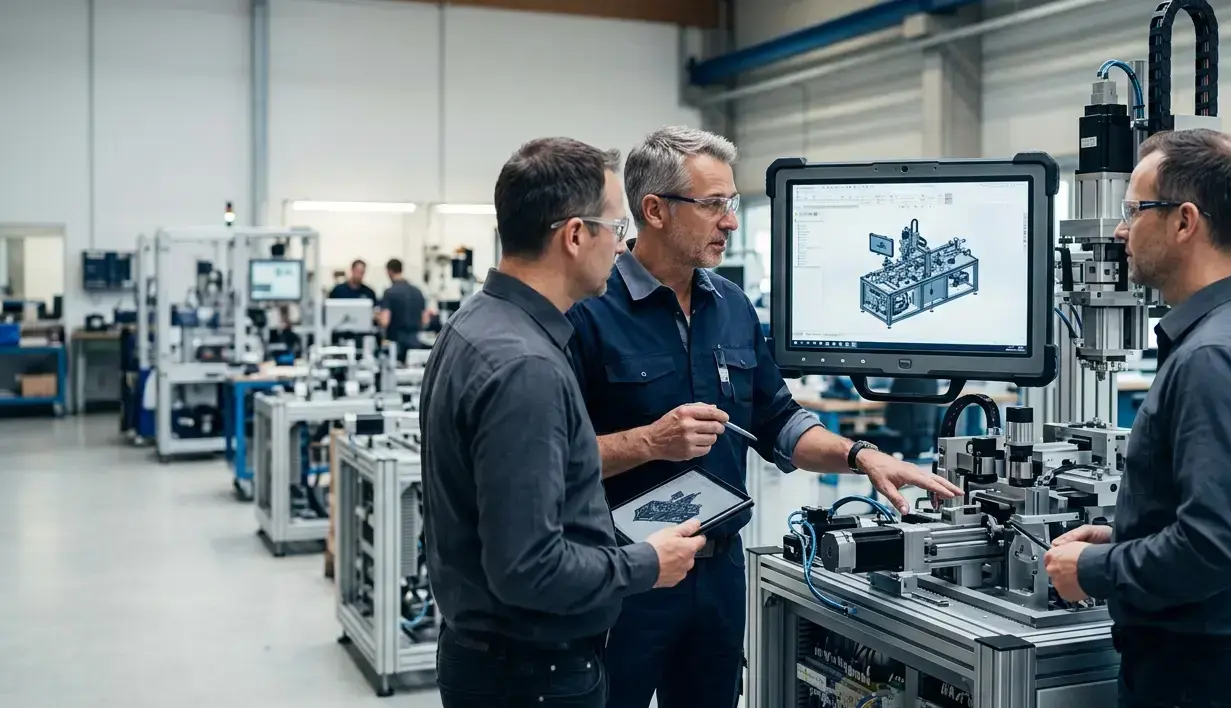
The Growing Shortage of Application Engineers in Special Machinery
Application Engineers connect customer requirements with technically viable machine solutions across sales, engineering and project delivery.
By LAK Consulting Group
Executive Summary
Special machinery companies create value by turning a customer's production requirement into a reliable technical solution. Application Engineers are central to this process. They assess feasibility, develop concepts, coordinate technical input and ensure that commercial proposals reflect what the organisation can realistically design and deliver.
The role is increasingly difficult to recruit because it combines engineering breadth with customer and commercial judgement. Candidates need to understand machinery, automation and production processes while communicating effectively with sales, design, project and customer teams. The strongest professionals can identify risk before an order is accepted and explain complex trade-offs in terms that support a purchasing decision.
When Application Engineering capacity is limited, enquiry response slows, specialist design teams become overloaded and poorly qualified projects can enter the order book. The shortage therefore affects revenue quality as well as technical workload. Machinery companies need clearer role definitions, stronger development pathways and a more deliberate approach to recruiting engineers from design, commissioning and adjacent capital-equipment markets.
Introduction
Special machinery is rarely sold from a standard specification alone. Customers describe an output, process, quality objective or production constraint, and the supplier determines how equipment can meet it. Materials, tolerances, cycle time, automation, safety, integration and service all influence the final concept.
Application Engineers operate at the point where this uncertainty must become a credible proposal. They ask technical questions, test assumptions and coordinate the expertise needed to define the solution. Their work takes place before the project team has the complete detail available after an order, but the decisions they support can shape cost and delivery throughout the lifecycle.
This position makes the role commercially significant. A strong Application Engineer helps the company pursue opportunities that fit its capability and price them with a realistic understanding of risk. A weak or overstretched function can allow ambiguity into the contract, where it becomes more expensive to resolve.
The Bridge Between Customer Need and Machine Concept
Customers usually understand the outcome they need, but they may not know which machine architecture will deliver it. Requirements can also contain conflicts. Higher throughput may affect quality or flexibility, while a compact footprint can limit access and maintainability. Application Engineers help expose these trade-offs early.
The work begins with understanding the production process. Engineers need information about materials, product variants, upstream and downstream equipment, operator interaction, environmental conditions and acceptance criteria. They also need to recognise where the customer's assumptions require trials or further evidence.
A credible concept combines mechanical, electrical and software perspectives. The Application Engineer may not design every subsystem, but they must coordinate specialist input and maintain a coherent view of the complete machine. This includes identifying interfaces and dependencies that could affect scope.
The concept then needs to be communicated. Customers require enough technical detail to evaluate the proposal, while internal teams need clear assumptions for costing and planning. Strong Application Engineers make uncertainty visible without making the solution appear undefined.
Why the Role Is Difficult to Define
Application Engineering varies considerably between machinery companies. In some organisations, the role is primarily technical presales. In others, it includes concept design, costing, testing, quotation preparation or early project ownership. The title may also be used for post-sales customer support.
This ambiguity creates recruitment problems. Candidates cannot judge the real scope, and employers compare people whose previous responsibilities were fundamentally different. A mechanical concept engineer, an automation specialist and a technical salesperson may all have held an Application Engineer title.
Effective role design begins with the decisions the person will own. Will they lead customer requirement workshops? Are they responsible for architecture and cycle-time calculations? Do they develop costs, write technical proposals or present the concept? At what point does responsibility transfer to the project team?
The answers should reflect the surrounding organisation. A company with strong central engineering support may need a customer-facing technical coordinator. A smaller specialist manufacturer may require a broader engineer capable of developing the concept more independently. Recruitment improves when this operating model is explicit.
The Technical Breadth Employers Need
Special machinery combines several engineering disciplines. Application Engineers need enough breadth to identify risks and involve specialists, even where their own background is deeper in one area.
Relevant capability may include:
- mechanical concepts, mechanisms, tooling and material handling;
- production processes, tolerances and quality requirements;
- motors, drives, pneumatics, hydraulics and other machine technologies;
- PLC, motion control, robotics, sensing and machine vision;
- safety concepts, guarding and operator interaction;
- cycle-time analysis, capacity and equipment availability;
- interfaces with factory systems and surrounding production equipment;
- installation, commissioning, maintenance and lifecycle support.
No single candidate will be expert in every technology. The role depends on knowing enough to ask the right questions and recognising where deeper review is necessary. Employers that present the complete list as mandatory can make an already difficult search unrealistic.
The required depth should follow the product. A high-speed assembly machine may prioritise motion, tooling and cycle-time knowledge. Process equipment may demand stronger understanding of thermal, fluid or material behaviour. An integrated robotic system requires more controls, safety and application expertise.
Commercial Judgement Is Equally Important
Application Engineers support revenue, but their responsibility is not simply to make every opportunity technically possible. They need to consider whether the proposed solution fits the organisation's capability, schedule and commercial priorities.
Custom requests can be attractive because they appear to create differentiation. They can also introduce one-off engineering, uncertain performance and service complexity. A strong Application Engineer identifies these consequences and helps leadership decide whether the opportunity justifies them.
Costing requires disciplined assumptions. Engineering hours, purchased components, testing, installation and contingency all depend on the concept. If uncertainty is hidden to make the quotation more competitive, the project team inherits risk without corresponding margin or schedule.
The role also influences negotiation. Customers may request changes after reviewing the proposal, and each change needs technical and commercial assessment. Application Engineers help sales teams explain why certain requirements affect price, delivery or performance rather than accepting them informally.
Why Experienced Candidates Are Scarce
Application expertise develops through exposure to real machines and customer projects. Engineers learn which details matter during concept development because they have seen the consequences during design, build, commissioning and production. This practical knowledge allows them to identify risk before complete information is available.
Candidates with this background are relevant to many employers. Machinery manufacturers, automation integrators, engineering consultancies and component suppliers all need people who can connect customer requirements with technical solutions. Experienced professionals may also move into technical sales, product management or project leadership.
The role can be demanding. Application teams manage several enquiries simultaneously, often under pressure to provide rapid responses. Priorities change as customers delay, accelerate or revise projects. Engineers need to coordinate internal specialists who are already committed to delivery work.
Some technically strong candidates avoid the role because they associate it with constant quotations and limited ownership. Employers need to present the engineering significance, decision authority and career path clearly. If the position is treated merely as support for sales, it may not attract professionals who value technical influence.
The Cost of Insufficient Application Capacity
When Application Engineering is understaffed, the first visible consequence is slower quotation. Sales teams wait for technical input, and customers may progress with competitors that can provide a credible response earlier. Urgency then increases, which can reduce the quality of review.
Design engineers are frequently asked to fill the gap. Their specialist knowledge is valuable, but repeated presales requests interrupt project work and product development. The organisation may appear to save headcount in Application Engineering while creating delay elsewhere.
Insufficient capacity can also weaken qualification. Teams focus on producing a concept without challenging whether the opportunity is strategically or commercially attractive. Poorly defined projects enter the order book and consume more engineering than expected.
The consequences continue into delivery. Project teams discover missing requirements or assumptions that were never communicated. Scope discussions become more difficult because the customer believes the original proposal included a different outcome. Stronger application work reduces this risk before contractual commitments are established.
Recruiting From Design Engineering
Mechanical, electrical, controls and systems engineers can transition successfully into Application Engineering. They bring technical depth and an understanding of how machinery is developed. The main question is whether they enjoy customer interaction, incomplete information and the commercial pace of presales work.
Assessment should explore how candidates communicate beyond their own discipline. Can they structure a requirement discussion, explain trade-offs and make a recommendation when information is incomplete? Do they know when to seek specialist support rather than solving every detail themselves?
The transition requires development in account context, opportunity qualification and costing. New Application Engineers should work alongside experienced sales and project colleagues so they understand how early decisions affect the complete commercial lifecycle.
The opportunity can be attractive for engineers who want broader responsibility and greater customer exposure. Employers should position it as a technical career path with meaningful influence, not as an exit from “real engineering”.
Recruiting From Commissioning and Service
Commissioning and service engineers possess valuable knowledge of how machines behave in customer environments. They understand installation, integration, operator interaction and the causes of production problems. This perspective can improve the realism of early machine concepts.
These professionals may also have strong customer communication skills developed under operational pressure. They know how to ask practical questions and recognise requirements that are difficult to deliver on site.
The transition into Application Engineering can provide a more predictable working pattern for candidates who want to reduce travel while retaining technical and customer responsibility. Employers should not assume that every field engineer wants an office-based role, but the pathway can support retention.
Development may be needed in concept costing, proposal structure and opportunity management. A service engineer is accustomed to diagnosing an existing machine; Application Engineering requires defining one that does not yet exist. Mentoring helps translate practical insight into forward-looking design decisions.
Our article on recruiting Service Engineers for international machinery markets examines the connected field-service talent market and the importance of sustainable career pathways.
Adjacent Markets and Transferable Capability
Application Engineers from industrial automation, robotics, process equipment, intralogistics and capital equipment may bring highly relevant capability. Their products differ, but they often work with complex requirements, multidisciplinary systems and long customer decision cycles.
Recruitment should examine the problems the candidate has solved rather than focusing only on machinery type. Did they develop custom concepts? Were they responsible for feasibility, costing and technical risk? Did they support handover into project delivery and learn from the result?
Some knowledge remains product specific. A candidate entering a new machinery sector may need exposure to customer processes, materials, performance standards and internal design methods. Structured onboarding should identify these gaps and provide access to specialists.
Adjacent recruitment can also introduce useful perspectives. An automation professional may strengthen controls and integration thinking, while someone from process equipment may bring disciplined application testing. Diversity of technical experience is valuable when the team maintains clear product standards.
Assessing Application Engineers
Interviews should test how candidates structure an uncertain technical problem. A practical scenario can provide a customer objective, incomplete process information and several constraints. Strong candidates clarify assumptions, identify risks and explain which evidence is needed before committing to a solution.
Useful areas to assess include:
- how the candidate gathers and prioritises customer requirements;
- how they coordinate input across engineering disciplines;
- how they balance performance, cost, schedule and technical risk;
- how they document assumptions and exclusions;
- how they respond when sales or customers request unsupported commitments;
- how they transfer the agreed concept to project delivery;
- what they learned from a project that performed differently from the original proposal.
Communication should be evaluated in realistic terms. The candidate may need to present to production managers, engineers, procurement and executives. They should adjust detail appropriately while maintaining consistency and accuracy.
Employers should also explain the workflow during recruitment. Strong candidates want to understand how opportunities are prioritised, which specialists support them and whether leadership respects technical qualification. These conditions affect both performance and retention.
Improving the Sales-to-Project Handover
Application Engineering creates value only when its decisions remain visible after the order. A disciplined handover should transfer requirements, assumptions, deviations, cost basis and unresolved risks to the project team.
The process should include discussion rather than document transfer alone. Project leaders and discipline engineers need an opportunity to challenge the concept and clarify customer commitments. The Application Engineer can explain why decisions were made and where flexibility remains.
Feedback should move in the opposite direction as well. Project and commissioning teams learn which assumptions were accurate and which created problems. If this information never reaches Application Engineering, the same weaknesses can recur in future proposals.
Regular review of completed projects helps improve costing, standard concepts and qualification. It also strengthens professional development because Application Engineers see the consequences of their early decisions.
Standardisation Without Losing Flexibility
Special machinery companies often want to reduce one-off engineering by reusing modules, controls and proven concepts. Application Engineers influence whether this standardisation succeeds because they decide how customer requirements map onto the available platform.
The role requires confidence to guide customers towards proven solutions where customisation adds limited value. It also requires judgement to recognise when a requirement is genuinely differentiating or technically unavoidable.
Standardisation should not become a claim that every application is identical. If the proposal hides differences, the project team will rediscover them later. Strong Application Engineers use defined options and boundaries to create flexibility without losing control.
Product management and engineering leadership need to support this approach. Application teams cannot defend standards if commercial leaders regularly override them without understanding the cost. Shared decision criteria help the organisation remain consistent.
Technical Sales and Application Engineering
Sales and Application Engineering should operate as partners with distinct accountability. Sales owns the customer strategy, opportunity and commercial progression. Application Engineering owns technical feasibility and the integrity of the proposed concept.
Conflict can be constructive when responsibilities are clear. Sales may challenge whether the concept communicates enough customer value, while Application Engineering challenges unsupported scope or performance assumptions. Leadership should expect this dialogue rather than rewarding agreement at any cost.
Staffing models should reflect enquiry complexity. Some opportunities need limited application support, while others require workshops, trials and multidisciplinary review. Allocating the same level of resource to every enquiry weakens both efficiency and quality.
The commercial contribution of Application Engineering should be visible. Metrics can include response quality, conversion, project margin and handover outcomes rather than quotation volume alone. This reinforces the role's influence on profitable growth.
Developing and Retaining Application Talent
Companies need a deliberate development route because the external market cannot provide every future Application Engineer. Design, commissioning, service and project employees can gain application responsibility gradually through supervised customer work and concept ownership.
Mentoring is essential. Experienced professionals hold practical knowledge about recurring risks, customer expectations and internal capability. New colleagues need access to this judgement, not only templates and product training.
Career progression should recognise technical and commercial growth. Senior Application Engineers may lead strategic proposals, define solution platforms, mentor teams or move into application leadership. They should not need to become general sales managers to gain recognition.
Workload affects retention. Constant urgent quotations and unclear priorities reduce the time available for quality engineering. Leaders need qualification processes that protect application resources and demonstrate that technical judgement is valued.
Executive Perspective
Application Engineering is a strategic capability within machinery and manufacturing technologies. It determines how effectively customer demand is translated into projects the organisation can deliver profitably.
Executives should understand whether application capacity matches the sales pipeline and product strategy. Growth plans that increase enquiries without strengthening technical qualification simply move risk into engineering and project delivery.
Workforce planning should identify where expertise is concentrated and which adjacent backgrounds could expand the team. A market map can show Application Engineers across machinery, automation and capital-equipment employers, while internal succession can create development routes from design or commissioning.
LAK Consulting Group supports these searches through technical talent acquisition, commercial talent acquisition and targeted market intelligence. The appropriate approach depends on whether the role is primarily concept engineering, technical presales or solution leadership.
Conclusion
Application Engineers make special machinery commercially and technically possible. They turn incomplete customer needs into structured concepts, coordinate specialist knowledge and protect the assumptions on which price and delivery depend.
The shortage reflects the role's unusual combination of engineering breadth, customer communication and commercial judgement. Employers need precise role definitions, realistic assessment and a willingness to recruit transferable capability from design, service, automation and adjacent capital-equipment markets.
Organisations that develop strong Application Engineering teams will respond to customers more credibly, use specialist resources more effectively and reduce avoidable project risk. Companies planning application or solution-engineering appointments can contact LAK Consulting Group to discuss candidate availability and recruitment strategy.
Frequently Asked Questions
What does an Application Engineer do in special machinery?
The role translates customer production requirements into a feasible machine concept, coordinates technical input, documents assumptions and supports a commercially sound proposal.
Why are Application Engineers difficult to recruit?
They need broad machinery knowledge, practical project experience, customer communication and commercial judgement. This combination develops over time and is relevant to many machinery and automation employers.
Can design engineers move into Application Engineering?
Yes. Mechanical, electrical and controls engineers can transition successfully when they enjoy customer interaction and receive development in qualification, costing and proposal work.
Why is the sales-to-project handover important?
It ensures that requirements, assumptions, deviations and unresolved risks remain visible after the order. A weak handover can create scope disputes, design rework and margin pressure.
How can machinery companies retain Application Engineers?
Clear priorities, technical authority, credible career paths, mentoring and recognition of the role's commercial contribution all support retention.
Discuss Your Recruitment Strategy
Every organisation faces different commercial, technical and leadership challenges. If you are planning to strengthen your team, expand into new markets or recruit for a business-critical position, we would be pleased to discuss your objectives and share our perspective on the market.
Book a Consultation