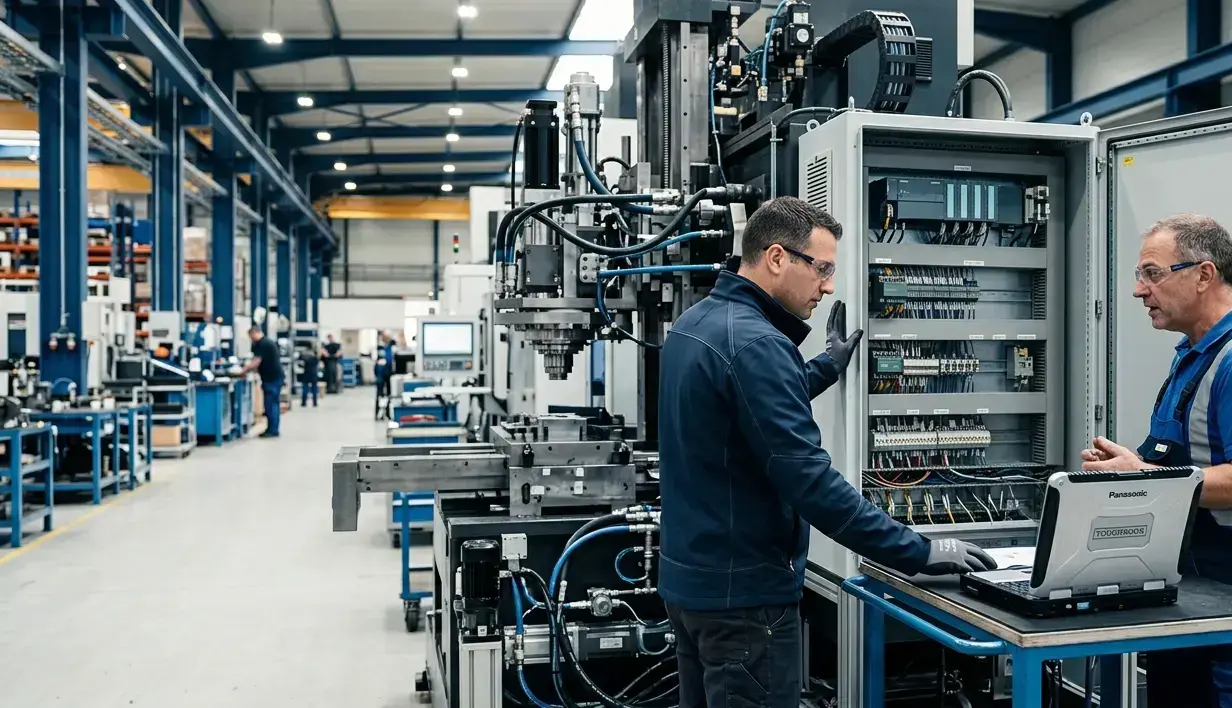
Recruiting Service Engineers for International Machinery Markets
Machinery companies need field-service professionals who can solve complex technical problems while representing the organisation effectively at customer sites around the world.
By LAK Consulting Group
Executive Summary
International machinery companies depend on service engineers to protect the performance of their installed equipment and the strength of their customer relationships. These professionals commission machines, diagnose faults, support maintenance teams and resolve urgent problems in operating production environments. They are often the supplier's most visible representatives after a machine has been delivered.
Recruiting them is becoming increasingly difficult. Employers need a combination of mechanical, electrical, controls and application knowledge, together with independence, communication skills and a willingness to travel. Candidates who possess this mix can choose between machinery manufacturers, automation suppliers, system integrators and end-user organisations, while experienced field engineers may eventually seek roles with less travel.
The challenge has direct commercial consequences. Weak service coverage can prolong downtime, delay acceptance, increase pressure on product-development teams and damage customer confidence. Machinery companies expanding internationally therefore need a deliberate service talent strategy that considers regional coverage, role design, development, retention and the transfer of knowledge from headquarters into local markets.
Introduction
Machinery manufacturers create value through more than the initial sale of equipment. Customers expect reliable commissioning, practical training, rapid technical support and access to specialists throughout the machine's operating life. In international markets, the quality of this support often influences whether a customer buys additional equipment, recommends the supplier internally or includes it in future investment programmes.
Service engineers sit at the centre of that relationship. They work where engineering decisions meet operational reality: on customer sites, under production pressure and often far from the colleagues who designed the machine. They need to identify problems quickly, communicate clearly and make sound decisions without compromising safety or creating further risk.
This makes service recruitment unusually demanding. Technical competence is essential, but it is not sufficient. The role also requires resilience, cultural awareness, customer judgement and the ability to represent the organisation professionally when circumstances are difficult. As machinery businesses grow across borders, finding and retaining professionals with this complete profile becomes a strategic priority.
Why Service Engineering Matters Commercially
Industrial machinery becomes part of the customer's production system. When equipment is unavailable, the consequences may include lost output, disrupted labour planning, delayed deliveries and pressure elsewhere in the process. The supplier's response is therefore evaluated not only as a technical intervention but as evidence of its reliability as a business partner.
A capable service engineer can protect that relationship. By diagnosing the problem methodically, explaining the situation and establishing a realistic recovery plan, the engineer gives the customer confidence that the issue is being controlled. Even when a repair requires additional parts or specialist input, transparent communication can prevent uncertainty from becoming dissatisfaction.
Service activity also creates valuable commercial insight. Engineers see how customers use equipment, where operating conditions differ from design assumptions and which improvements would create practical value. They may identify opportunities for upgrades, preventive maintenance, training or replacement equipment. Organisations that connect this information with product management and sales can improve both the installed base and future offerings.
The contribution continues during installation and acceptance. Effective commissioning shortens the path from delivered equipment to stable production, while good operator and maintenance training reduces avoidable problems later. Service capability therefore influences project cash flow, customer satisfaction and the lifetime economics of the installed machine.
The Capabilities International Service Roles Require
Machinery service positions vary significantly. Some focus on planned commissioning, others on emergency response, maintenance, retrofits or application optimisation. Employers should define the role around the equipment, customer environment and expected field responsibility rather than using a generic service-engineer description.
Typical capability requirements include:
- mechanical fault-finding across assemblies, drives, tooling, hydraulics or pneumatics;
- electrical diagnosis involving motors, sensors, safety circuits and power distribution;
- PLC, HMI, motion-control or robotics knowledge appropriate to the machine platform;
- structured commissioning, testing and acceptance procedures;
- interpretation of drawings, documentation and diagnostic information;
- customer communication, training and accurate service reporting;
- safe, independent work within unfamiliar production environments;
- coordination with engineering, spare-parts, project and commercial teams.
Few candidates possess identical depth across every area. The appropriate balance depends on the product. A mechanically complex process machine may require stronger mechanical and application expertise, while an automated production system may place greater emphasis on controls and software. Recruitment becomes more effective when leaders distinguish essential capability from knowledge that can be developed through product training.
International responsibility adds another dimension. Engineers need to navigate language differences, local working practices and varying levels of customer technical capability. They must understand when to solve an issue independently, when to escalate and how to maintain alignment with headquarters across time zones. The best service professionals combine confidence with disciplined judgement.
Why Experienced Service Engineers Are Difficult to Recruit
Practical service expertise is developed in the field. Engineers learn how equipment behaves after transport, installation and extended operation. They encounter unusual combinations of component wear, environmental conditions, operator behaviour and upstream process variation. Over time, they build a mental library of symptoms and causes that allows them to diagnose problems more efficiently.
This experience is valuable across several markets. A service engineer from special machinery may be attractive to automation integrators, packaging-equipment manufacturers, process-technology suppliers or production companies building their internal maintenance capability. Candidates with strong controls knowledge may also move into commissioning, application engineering, project management or technical sales.
Travel requirements reduce the available pool. International service can offer variety, autonomy and exposure to different customers, but frequent travel becomes difficult to sustain for some professionals over the long term. Unpredictable scheduling, weekend disruption and extended periods away from home can outweigh the technical attraction of the work. Employers competing only through salary may fail to address the underlying reasons candidates decline or leave.
The role can also be misunderstood during recruitment. Phrases such as “international travel required” provide little useful information. Candidates want to know typical travel frequency, trip duration, notice periods, weekend expectations, regional scope and how the company manages recovery time. Lack of clarity weakens trust and increases the risk of an appointment that does not last.
Headquarters Coverage Versus Local Service Teams
Machinery companies often begin international expansion by supporting overseas customers from a central European service organisation. This approach can work while the installed base is limited, particularly when machines require deep product knowledge available only at headquarters. As sales grow, however, long-distance coverage can become slower, more expensive and harder for engineers to sustain.
Local service capability can improve response times, language alignment and customer proximity. It can also reduce travel pressure on the central team. The challenge is ensuring that regional engineers receive sufficient training, documentation and access to product specialists. Hiring a local engineer without the surrounding support structure transfers responsibility but not necessarily capability.
Many organisations need a hybrid model. Regional engineers handle planned activity, first response and common technical issues, while headquarters provides advanced diagnostics, engineering escalation and support for major installations. Clear ownership and communication are essential so that customers are not passed between teams and local engineers do not feel isolated.
The decision to establish local coverage should be linked to installed-base density, customer expectations, travel cost and the technical complexity of the product. It should also consider future commercial strategy. A strong regional service presence can make further machinery sales more credible because customers know support is available after delivery.
Recruiting in New International Markets
Local recruitment requires more than translating a domestic job description. Candidate availability, compensation structures, qualifications and expectations differ between countries. Job titles may not correspond directly, and the strongest talent may work for distributors, service partners or end users rather than direct machinery competitors.
Market mapping can clarify where relevant professionals are located and which adjacent employers provide transferable experience. It can also reveal whether one regional role is realistic or whether the required geography is too broad. A service engineer expected to cover several distant countries may face the same travel burden as a headquarters-based employee without receiving the support of an established local team.
The first regional appointment is particularly important. That person may need to establish service processes, build relationships with headquarters and represent the company before local infrastructure is fully developed. Technical strength must be combined with independence and organisational maturity. Our article on international expansion and hiring the right local team explores the broader importance of early local appointments.
Employers should also define the employment and management structure clearly. Candidates need to know who sets priorities, how performance is evaluated and which resources are available. Ambiguity between local commercial leadership and central service management can create conflicting instructions, especially when customer emergencies compete with planned work.
Assessing Technical Ability and Customer Judgement
Service recruitment should test how candidates approach problems, not only which machine brands they have encountered. Structured technical discussions can explore how the individual would isolate a fault, validate a hypothesis and decide whether equipment is safe to return to operation. The objective is to understand reasoning and discipline rather than reward quick but unsupported answers.
Practical scenarios can also reveal customer judgement. A strong engineer should be able to communicate uncertainty without appearing evasive, manage pressure without making unrealistic promises and document findings accurately. They need to know when a temporary workaround is appropriate and when it would expose the customer or employer to unacceptable risk.
Language capability should be assessed in relation to actual work. Conversational confidence may be sufficient for some internal exchanges but not for delivering technical training, documenting acceptance or explaining a safety issue. At the same time, requiring perfect language skills where they are not essential can exclude technically strong candidates. The standard should reflect the customer interaction the role genuinely involves.
Cultural adaptability is harder to assess through direct questions. Evidence from previous travel, international project work, remote collaboration or unfamiliar customer environments can be more useful. Candidates should be able to describe how they adapted their communication while maintaining technical and safety standards.
Developing Service Engineers Internally
External recruitment alone cannot provide every service professional a growing machinery company needs. Organisations should create development routes from assembly, testing, commissioning and internal technical-support roles. Employees in these functions often possess valuable product knowledge and can transition successfully when they receive customer-facing and field experience.
A structured pathway reduces risk. New service engineers can begin with supervised installations, planned maintenance and defined equipment families before taking responsibility for complex faults. Shadowing experienced colleagues helps them learn not only technical procedures but how to communicate with customers and organise work on site.
Product training must remain current as machinery evolves. Service organisations are sometimes introduced to design changes shortly before delivery, leaving limited time to understand diagnostics or spare-parts implications. Involving senior service representatives in development reviews can improve maintainability while preparing the team for new platforms.
Documentation is equally important. Service knowledge often resides in personal notes or individual memory, particularly in businesses with highly customised machinery. Consistent fault records, commissioning reports and shared technical guidance make the organisation less dependent on a small number of experts. They also accelerate the development of new employees and regional teams.
Retaining Professionals in Travel-Intensive Roles
Retention begins with an honest employment proposition. Candidates should understand the travel model before joining, including how emergency work, overtime and time away are managed. Employers that minimise these demands during recruitment may fill a vacancy but create a future resignation.
Planning quality affects daily experience. Some disruption is unavoidable in international service, but repeated last-minute deployment often reflects insufficient capacity or weak coordination. Better scheduling, regional coverage and remote diagnostic support can reduce unnecessary travel while improving customer response.
Career development also matters. Experienced service engineers may want to progress into technical leadership, training, application engineering, service management or product support. If the only perceived route away from intensive travel is leaving the company, organisations will lose valuable knowledge. Flexible career paths can retain expertise while adapting responsibilities over time.
Recognition should reflect the commercial importance of the work. Field engineers frequently manage difficult customer moments with limited supervision. Leadership visibility, appropriate authority and inclusion in product decisions demonstrate that service is valued as a professional discipline rather than treated merely as a cost centre.
Remote Support and Digital Service Tools
Connected machinery and remote diagnostics can improve service efficiency. Secure access to machine data, alarms and control systems may allow specialists to prepare before travelling or resolve some issues without a site visit. Digital documentation and collaboration tools can also connect regional engineers with product experts more effectively.
These technologies change the service role but do not eliminate it. Remote data still requires interpretation, and many mechanical, process or safety issues need physical inspection. Customers may also restrict remote access for security or operational reasons. Organisations need professionals who can use digital tools while understanding their limitations.
Remote support can nevertheless improve retention and scalability when designed well. Senior experts can advise several regional engineers without travelling to every intervention, while newer employees gain access to guidance during difficult assignments. This model depends on clear escalation processes and sufficient capacity at headquarters; otherwise remote specialists simply become another overstretched bottleneck.
Service Leadership and Organisational Design
Service leaders balance customer urgency with workforce sustainability. They need to allocate scarce expertise, maintain response standards and ensure that immediate problems do not prevent training, documentation and preventive work. In international organisations, they must also align central product knowledge with local customer responsibility.
Commercial discipline is part of this role. Service agreements, warranty decisions, spare-parts strategy and chargeable support all influence customer value and profitability. Leaders need credible operational data to distinguish recurring product issues from application, maintenance or training needs. This insight should flow back into engineering and product management.
The organisational position of service sends a signal. When service leadership participates in product, quality and market discussions, field experience can influence decisions before problems repeat. When the function is measured only on cost and immediate response, improvement and long-term customer value receive less attention.
Executive Perspective
International growth within machinery and manufacturing technologies depends on the organisation's ability to support customers after equipment is sold. A growing installed base without corresponding service capacity creates operational and reputational exposure. Executive teams should therefore include service workforce requirements in market-entry plans, product launches and sales forecasts.
The talent strategy needs to identify where deep product expertise should remain central and where local coverage will create advantage. It should also address succession, travel sustainability and the development of future specialists. Waiting until response times deteriorate or experienced engineers resign makes the problem more expensive to solve.
Specialist recruitment can support immediate gaps, but market intelligence is equally useful. Understanding where service talent works, which companies develop relevant capability and what motivates candidates allows leaders to make more realistic expansion decisions. LAK Consulting Group supports machinery businesses through technical talent acquisition, international recruitment and targeted market mapping.
Conclusion
Service engineers protect the operational value of industrial machinery and the customer relationships built around it. Their contribution spans commissioning, troubleshooting, maintenance, training and continuous improvement. In international markets, they also represent the supplier across different languages, cultures and production environments.
Recruiting these professionals is difficult because the role combines technical breadth, customer judgement, independence and travel. Machinery companies need precise role definitions, realistic regional structures and assessment that examines practical problem-solving rather than job titles alone. They must also develop internal talent and create sustainable careers for experienced field professionals.
Organisations that invest in service capability alongside sales expansion will be better positioned to protect uptime, strengthen customer confidence and grow their installed base. Companies planning international service appointments can contact LAK Consulting Group to discuss candidate availability and the most appropriate recruitment strategy.
Frequently Asked Questions
Why are international machinery service engineers difficult to recruit?
The role requires multidisciplinary technical knowledge, independent problem-solving, strong customer communication and willingness to travel. Candidates with this combination are relevant to many machinery and automation employers.
Should machinery companies recruit service engineers locally?
Local recruitment can improve response time and customer proximity when the installed base justifies it. Regional engineers still need structured training, escalation routes and access to specialists at headquarters.
Which adjacent backgrounds can provide suitable candidates?
Commissioning, machine testing, industrial maintenance, controls engineering, automation integration and technical product support can all provide transferable experience, depending on the machinery involved.
How should employers assess service engineers?
Assessment should examine technical reasoning, fault-finding discipline, safety judgement, communication and evidence of working independently in customer environments. Platform experience alone is not sufficient.
How can companies retain engineers in travel-intensive service roles?
Clear travel expectations, better planning, fair recovery arrangements, regional support and credible career routes into technical leadership, training or application engineering all improve retention.
Discuss Your Recruitment Strategy
Every organisation faces different commercial, technical and leadership challenges. If you are planning to strengthen your team, expand into new markets or recruit for a business-critical position, we would be pleased to discuss your objectives and share our perspective on the market.
Book a Consultation